Histoire
La Mésopotamie : le pays entre les fleuves
Une plaine plate bâtie de limon, sans presque aucune pierre, aucun bois ni aucun métal en propre. Les villes y sont pourtant apparues les premières, et ces pénuries y sont pour beaucoup.
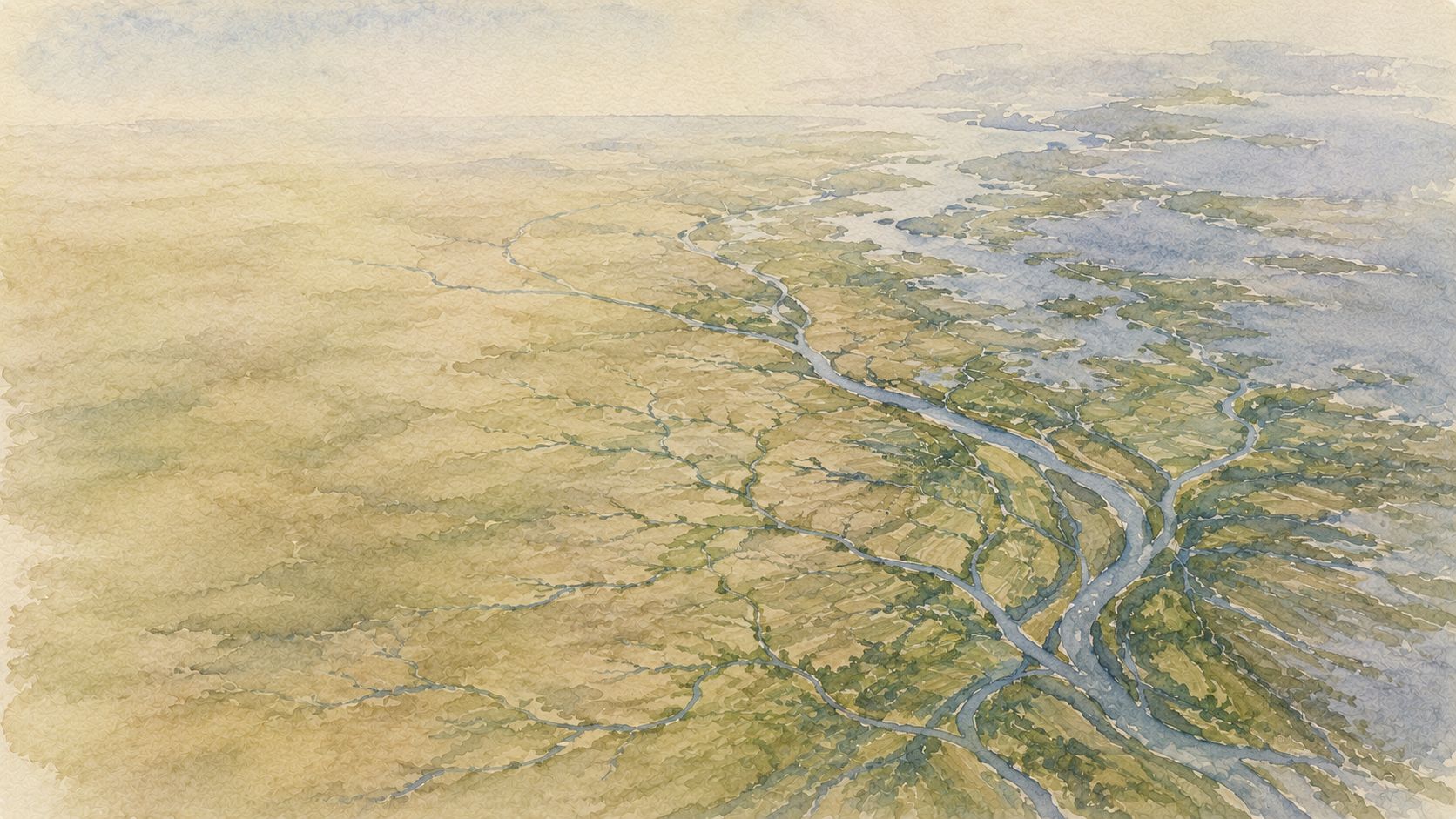
Mésopotamie est un mot grec qui signifie entre les fleuves, et le pays qu'il nomme est la plaine alluviale déposée par le Tigre et l'Euphrate dans ce qui est aujourd'hui le sud de l'Irak. Tout le reste de ce site s'y déroule.
Il vaut la peine de comprendre ce lieu physiquement, car les deux faits qui l'ont façonné sont d'une simplicité presque gênante : il y a de l'eau si on la déplace, et il n'y a rien d'autre.
Un pays fait de limon fluvial
La plaine du sud n'est pas de la vieille roche recouverte de terre. Elle est le dépôt des fleuves eux-mêmes, des milliers d'années de limon abandonné par le courant qui ralentit, accumulé en une plaine d'inondation presque parfaitement plate, traversée de chenaux mouvants et s'ouvrant, à son extrémité sud, sur les marais.
Parce qu'elle est aussi plate, les fleuves divaguent. Un chenal qui nourrissait une ville pouvait se déplacer, et il l'a fait, et une ville nourrie par un chenal qui se déplace était en grand danger. Plusieurs sites antiques se trouvent aujourd'hui très loin de toute eau.
Les pluies du sud ne suffisent pas à cultiver. Ce seul fait exclut la manière évidente de vivre et impose l'autre.
Le surplus venait de l'irrigation, et l'irrigation exige l'entente
Arrosez la plaine et elle devient extraordinairement productive. Le limon est fertile, la saison de croissance est longue, et l'orge irriguée peut donner des rendements très élevés.
Mais l'irrigation n'est pas une affaire de foyer isolé. Il faut creuser les canaux, puis ils s'envasent et il faut les curer, chaque année, pour toujours. L'eau prise en amont est de l'eau qui n'arrive pas en aval. Le travail doit être organisé, l'entretien doit être imposé, et les litiges doivent être tranchés par quelqu'un.
Ainsi le surplus qui a nourri les premiers habitats denses ici n'était pas un don du sol ; il était le produit d'un travail coordonné. Voilà la version honnête de la raison pour laquelle les villes apparaissent sur cette plaine : non parce que c'était facile, mais parce que la rendre productive obligeait les gens à s'organiser à grande échelle, à tenir le compte des obligations et à répondre devant un centre.
Les pénuries qui ont bâti une civilisation
La plaine n'a presque pas de pierre à bâtir, très peu de bois et aucun minerai métallique. Ce qu'elle possède, en quantité pour ainsi dire illimitée, c'est de la boue et des roseaux.
On a donc bâti en brique crue et en roseau, et on a échangé pour tout le reste : le bois des montagnes, la pierre, le cuivre, et le lapis-lazuli qui venait de quelque trois mille kilomètres, de ce qui est aujourd'hui l'Afghanistan. Une perle de lapis dans une tombe d'Ur est le reçu d'un réseau d'échanges franchissant montagnes et déserts.
Et parce que l'argile était la matière sous la main, c'est sur l'argile qu'on a écrit. Ce n'est pas un petit accident. Le papyrus pourrit et le parchemin brûle, mais l'argile cuite est presque indestructible : une civilisation qui a écrit sur la chose la moins chère dont elle disposait est celle dont nous pouvons encore lire les documents ordinaires cinq mille ans plus tard. La pauvreté de cette plaine en toute matière sauf la boue est la raison pour laquelle nous en savons tant.
Ce qui est attesté, et ce que nous ajoutons
Chaque page factuelle est écrite d'après une fiche de référence qui sépare les preuves du récit, affirmation par affirmation. Voici cette fiche, intégralement.
Période : Des périodes d'Obeid à Uruk, Basse Mésopotamie (vers le 6e au 4e millénaire av. n. è.)
Ce que les sources soutiennent
- Mésopotamie signifie « entre les fleuves » (grec) ; le pays est la plaine alluviale bâtie par le limon du Tigre et de l'Euphrate, dans l'actuel sud de l'Irak.
- Les marais et les bras du sud permettaient d'irriguer ; c'est ce surplus, et non la pluie, qui a d'abord nourri un habitat dense ici.
- La plaine n'a presque ni pierre, ni bois, ni métal en propre : on y a bâti en brique crue et en roseau, et échangé pour le reste ; l'argile et le roseau sont devenus les matériaux du quotidien, écriture comprise.
Ce que notre récit ajoute
La chronique parle de cette plaine comme d'un lieu ancien et de longue mémoire. C'est une ambiance, non une affirmation.
Ce que nous n'affirmons jamais
Que les fleuves, la terre ou ses peuples aient été faits ou façonnés par quiconque extérieur au document humain, ou que les marais dissimulent quoi que ce soit de nôtre.
Sources
- Wikipedia: Mesopotamia
- Wikipedia: Tigris–Euphrates river system
- Wikipedia: Mesopotamian Marshes
- Wikipedia: Ubaid period
- Référence
HIST_LAND_BETWEEN_RIVERS- Dernière révision
Citation suggérée : Chroniques d'Uruk, « Le pays entre les fleuves » (HIST_LAND_BETWEEN_RIVERS), révisé le 2026-07-26.
Les lectures des signes et des noms sumériens suivent l'usage savant là où une valeur est bien attestée, et sont signalées pour examen spécialisé là où elle est discutée. Si vous relevez une erreur, écrivez-nous.
Dans la chronique
La chronique parle de cette plaine comme d'un lieu ancien et de longue mémoire. C'est une atmosphère, non une affirmation.
Les fleuves, la terre et les gens qui s'y sont établis appartiennent au registre. Nous n'y ajoutons rien.
Questions fréquentes
- Où se situe exactement la Mésopotamie ?
- Le pays entre le Tigre et l'Euphrate, dont l'essentiel correspond à l'Irak actuel, avec des prolongements en Syrie, dans le sud-est de la Turquie et en Iran. Les villes sumériennes présentées sur ce site se trouvent dans la plaine alluviale méridionale, près des marais et du fond du Golfe.
- Pourquoi les premières villes sont-elles apparues ici plutôt qu'en un lieu plus facile ?
- En partie parce que l'agriculture irriguée sur ce limon produit un très large surplus, et en partie parce qu'obtenir ce surplus exige de l'organisation : des canaux à creuser et à curer, des droits d'eau à arbitrer, du travail à coordonner. La plaine récompensait ceux qui bâtissaient des institutions, et ces institutions sont l'essentiel de ce qu'est une ville.
- Pourquoi écrivaient-ils sur de l'argile ?
- Parce que l'argile était la matière abondante et que la pierre, le bois et le papyrus ne l'étaient pas. Il s'est trouvé que c'était la surface d'écriture la plus durable jamais employée : les tablettes d'argile survivent à l'incendie, à l'enfouissement et aux millénaires, ce qui explique que la vie quotidienne mésopotamienne soit mieux documentée que celle de bien des sociétés plus tardives et plus riches.
Poursuivre la lecture
Quand des tablettes sincères se contredisent
Cinq récits sincères d'un même événement, et comment les lire.
Les sceaux-cylindres
Une signature et une serrure d'un même geste roulé.
Les dépôts de fondation
Des messages enfouis dans les assises, adressés au bâtisseur suivant.
Les Anunnaki
Qui étaient vraiment les Anunnaki dans la croyance sumérienne, et comment une famille de dieux anciens devint un mythe moderne.
Continuez à explorer la Chronique