History
Every sign we use, and what it means
The complete lexicon behind Chronicles of Uruk: 84 cuneiform signs, each with its scholarly reading and a plain-English meaning. Free to read, free to cite.
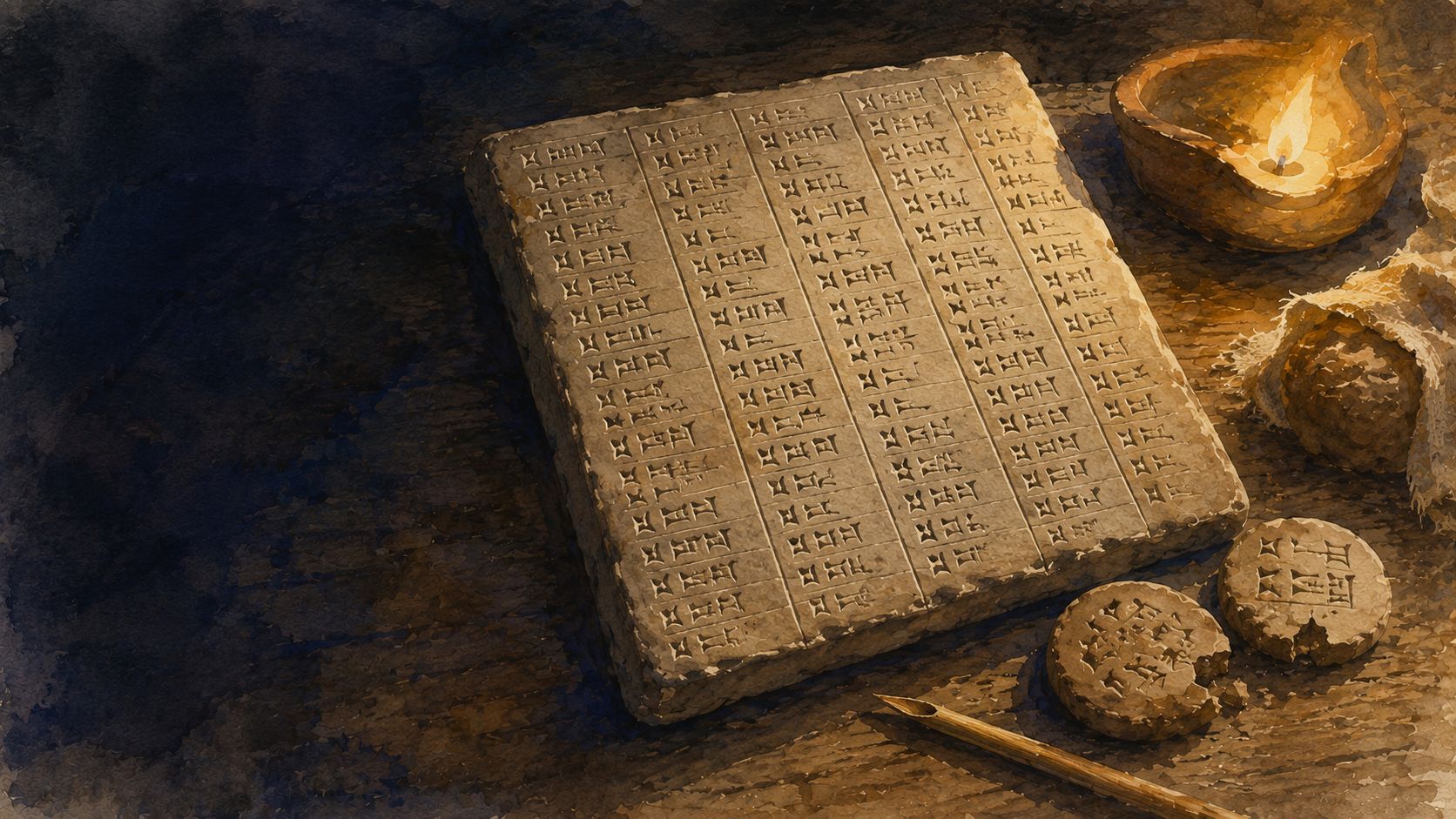
Cuneiform is not an alphabet. A sign can stand for a whole word, for a syllable, or for a silent hint about what kind of thing follows. These are the signs that appear in our world, drawn from the writing the scribes of Sumer actually used, with the reading a specialist would give each one.
Things you can picture
Signs whose meaning is a thing or an act. Many began as a drawing of it.
Sign MU
name; year; the verbal prefix mu-
Sign KA
mouth; voice; to speak
Sign GI
reed; to be firm, to establish
Sign E2 (É)
house, temple, household
Sign KA2 (KÁ)
gate, gateway, doorway
Sign KESH2 (KEŠ)
to bind, to tie together; the city Keš
Sign MUL
star; to shine, radiate (written as the AN sign three times)
Sign DUB
clay tablet; to heap up
Sign IGI
eye; to see; to open the eyes
Sign SHA3 (šag₄)
heart, interior, the inner self
Sign A
water; watercourse; (phonetic a)
Sign GISH (GIŠ)
tree, wood (also the determinative for wooden things)
Sign LU
sheep; (phonetic lu)
Sign GUD (gu₄)
bull, ox
Sign URU (IRI)
city, town
Sign KUR
mountain; foreign land; the netherworld
Sign AD
father (ad-da); (phonetic ad/at)
Sign AMA (GA2-times-AN)
mother
Sign AM (GUD-times-KUR)
read am; a wild bull (am); phonetic am in a syllabic name
Sign HA (ḫa)
fish (written ḪA, read ku₆); abundance; (phonetic ḫa)
Sign ZA
(phonetic za); stone, bead; first sign of za-gin₃, lapis lazuli
Sign SA
sinew, cord, net; a string of a lyre — the sign the owner's amulet carries for the heart of the pair heaven-earth
Sign SI
horn; to fill, to make straight — (with the eye, si—igi, to look straight at)
Sign SHU (ŠU)
hand; to entrust, to hand over (with TI in šu—ti, 'to receive, to take')
Signs that write the powers
The signs that spell the names of the gods. Almost every divine name opens with the same one.
Sign AN
heaven, sky; a god (also the divine determinative, DINGIR)
Appears in: An, Enlil, Enki, Nanna, Utu, Inanna, Ereshkigal, Nergal, Ninshubur, Dumuzid, Geshtinanna, Neti, Ninsun
Sign TUG2
garment, cloth (forms NIN, 'lady/queen', in the writing SAL.TUG2)
Appears in: Ereshkigal, Ninshubur, Ninsun
Sign MUSH3 (MÙŠ)
the sign that WRITES the goddess Inanna (Ištar) — her rosette, the eight-pointed star, said in wedges rather than drawn
Appears in: Inanna
Sign ZI
life, breath; true, faithful; (phonetic zi); the second sign of dDUMU.ZI (Dumuzid)
Appears in: Dumuzid
Sign GESHTIN (ĝeštin)
vine, grape, wine; in dĜEŠTIN.AN.NA (Geshtinanna), 'vine of heaven'
Appears in: Geshtinanna
Sign NE
fire, brazier; (phonetic ne); the first sign in the gatekeeper's name dNE.TI (Neti)
Appears in: Neti
Sign SHUBUR (šubur)
the element šubur, as in dNIN.ŠUBUR (Ninshubur), the minister who does not weep
Appears in: Ninshubur
Signs that write the cities
Place names were written with signs for dwelling, earth and water, and often a city and its god shared a hand.
Sign KI
earth, ground, place (also the determinative for places)
Appears in: Enki, Nanna, Ereshkigal, Enkidu, Uruk, Ur, Eridug, Nippur
Sign UNU (AB-gunû)
dwelling, seat; read unug in UNUG.KI, the city Uruk, and in ŠEŠ.UNUG.KI, the city Ur; the third sign of dGIR₃.UNU.GAL (Nergal)
Appears in: Nergal, Uruk, Ur
Sign NUN
prince, noble; the Apsû; (in a-nun-na, the Anunna); NUN.KI writes the city Eridug, Enki's house over the Apsû
Appears in: Eridug
Sign LIL2 (líl)
wind, breath, moving air; the open air; in Enlil (den-líl), 'Lord Wind'
Appears in: Enlil, Nippur
Sign SHESH (ŠEŠ)
brother; in ŠEŠ.UNUG.KI it writes the city Ur, and in AN.ŠEŠ.KI the moon-god Nanna: god and city written with one hand
Appears in: Nanna, Ur
Sound and grammar
Signs carrying a syllable or a grammatical ending rather than a picture. In a name, a sign like this is only carrying sound.
Sign DU
to go, to walk, to come
Sign ZU
to know; wisdom; tooth
Sign KU3 (KÙ)
pure, holy, bright; silver, precious metal
Sign NAM
fate, destiny; the abstract-noun prefix nam- (in NAM.TAR, 'the cutting of fate')
Sign PA
branch, staff, sceptre; an overseer or foreman (the one who carries the staff)
Sign TAR
to cut, to separate; to decide (in NAM.TAR, 'the cutting of fate')
Sign RI
to lead away, to cast off; distant, remote (also a syllabic value in names)
Sign SUD
far, distant; long-lasting; to draw out
Sign NAGA
a soda/potash plant; the sign that writes the goddess Nisaba/Nidaba
Sign BAL
to cross over, to turn, to transgress
Sign GI4
to return, to turn back, to answer
Sign UR
dog; in personal names, the man of, the servant of; hero, warrior
Sign DIM2 (dím)
to fashion, to make, to build
Sign MA
(phonetic ma); to bind; a basket
Sign RA
(phonetic ra); to strike; the -ra (dative) case ending
Sign E
(phonetic e); to speak, to say
Sign LA
(phonetic la); abundance, luxuriance; to hang
Sign NU
negation (not, no); image, likeness; (phonetic nu)
Sign DUN3-gunû (gim)
read gim; the second sign in dGIŠ.GIM.MAŠ (Gilgamesh)
Sign MASH (MAŠ)
twin; half; a kid (young goat); interest on a loan
Sign NI
(phonetic ni); self; oil (ì)
Sign U
(phonetic u); the number ten; a plant
Sign SHA (ša)
(phonetic ša)
Sign RU
to send, to throw; to give, to bestow
Sign GU
(phonetic gu); thread, flax; neck
Sign TE
(phonetic te); to approach; cheek
Sign AB
window, opening; in a-ab-ba (𒀀𒀊𒁀), 'the sea' — the salt deep personified as Tiamat
Sign ME
the me: an ordering decree of civilization, a pattern reality is told to follow; (phonetic me)
Sign LU2 (LÚ)
man, person; the one who — opens the bracelet's line
Sign KALAG (KAL)
strong, mighty; to strengthen — with LÚ before it, the mighty one
Sign UN
the people, the population — the third sign of the rosary head piece's line
Sign ASH2 (AŠ₂)
wish; curse — one sign for both, for a wish aimed at somebody is one
Sign TUSH (TUŠ, the KU sign)
to sit, to dwell, to stay; a body asked to keep its place
How to trust this list
Each reading is the sign's standard sign-list value, anchored to its Unicode sign name, so you can check it against any reference. The meanings are ours: accurate to standard Assyriology where a sign's value is well attested, and flagged for specialist review where it is contested. If you find an error, we want to hear about it.
There are 84 signs here, not the whole writing system. Unicode encodes over a thousand cuneiform characters and a working scribe knew several hundred. This list is deliberately the signs our own world uses, so that every sign we print, we can explain.
Keep exploring the Chronicle