History
Cuneiform, the first writing
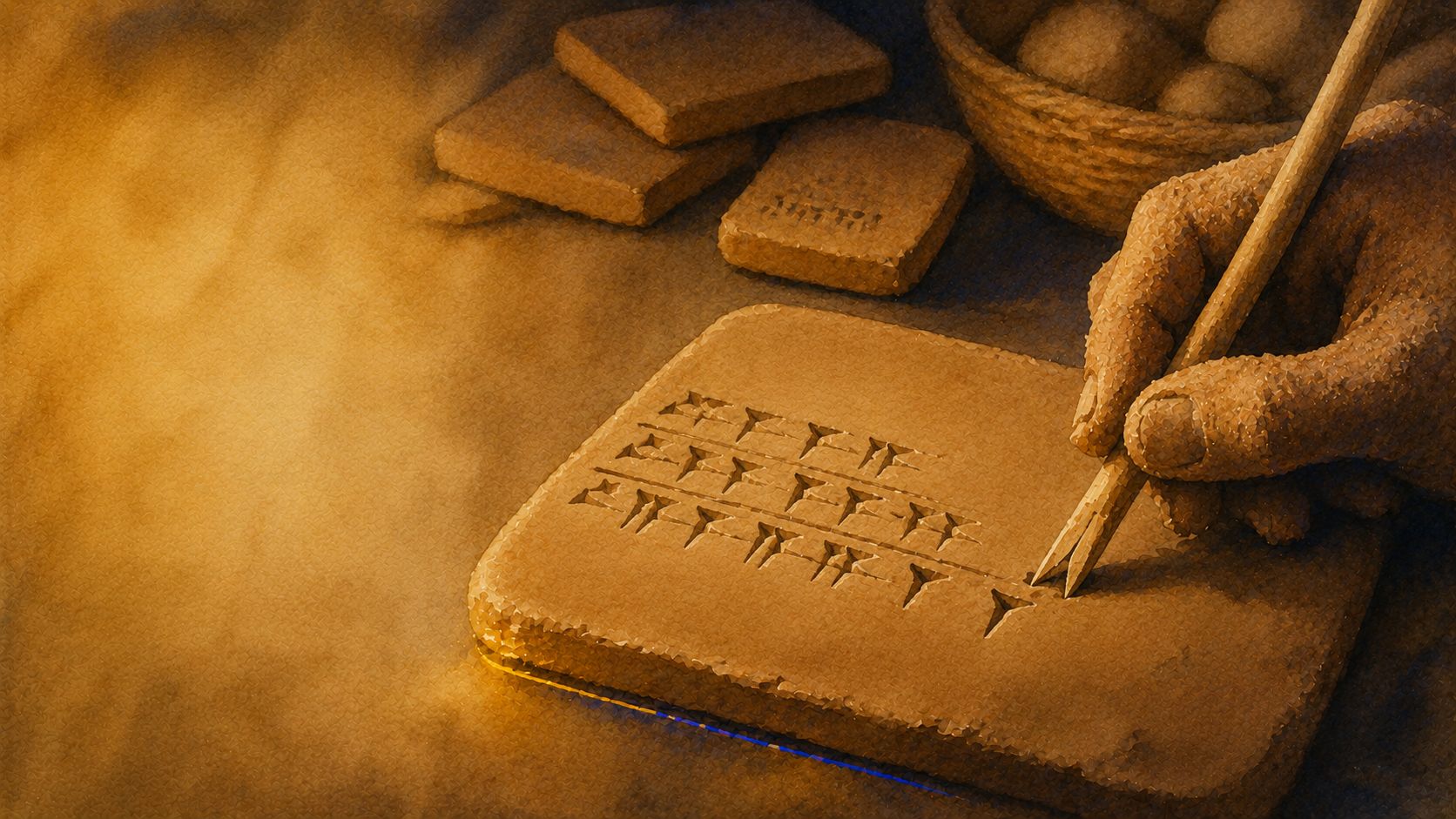
The oldest writing in the world was not carved in stone or brushed in ink. It was pressed into wet clay with a cut reed, one wedge at a time, in the cities of ancient Sumer. We call it cuneiform, and it still speaks.
Cuneiform is the earliest writing system we can read, first used in Mesopotamia more than five thousand years ago. For three thousand years it recorded receipts and laws, letters and love poems, mathematics and the oldest myths, across a dozen languages. Learning even a few of its signs changes how you look at the ancient world.
From tokens to tablets
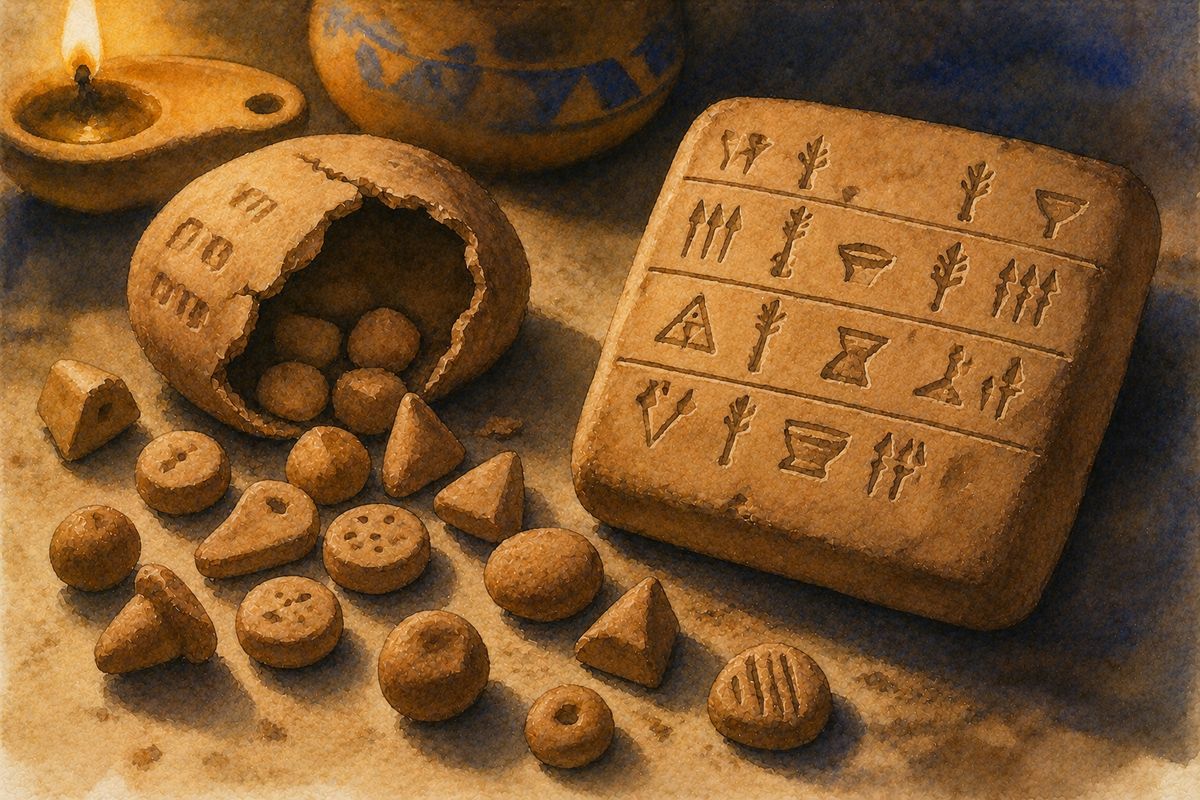
Writing did not begin with poetry. It began with counting. For thousands of years, Mesopotamians tracked goods with small clay tokens, sometimes sealed inside clay envelopes. Around 3300 BCE, in Uruk and cities like it, scribes began pressing the shapes directly onto flat tablets instead, along with simple pictures of the things being counted.
Those early signs were pictographic: a drawing of a head, an ox, a sheaf of grain. Over generations the pictures were simplified into groups of wedge-shaped marks, quick to press into clay with the corner of a reed stylus. The name cuneiform comes from the Latin for wedge.
A script that outlived its language
Cuneiform was invented to write Sumerian, but it did not stay with one language. It was borrowed to write Akkadian, the tongue of Babylon and Assyria, and later Elamite, Hittite, and others. A single script carried the words of many peoples for three thousand years.
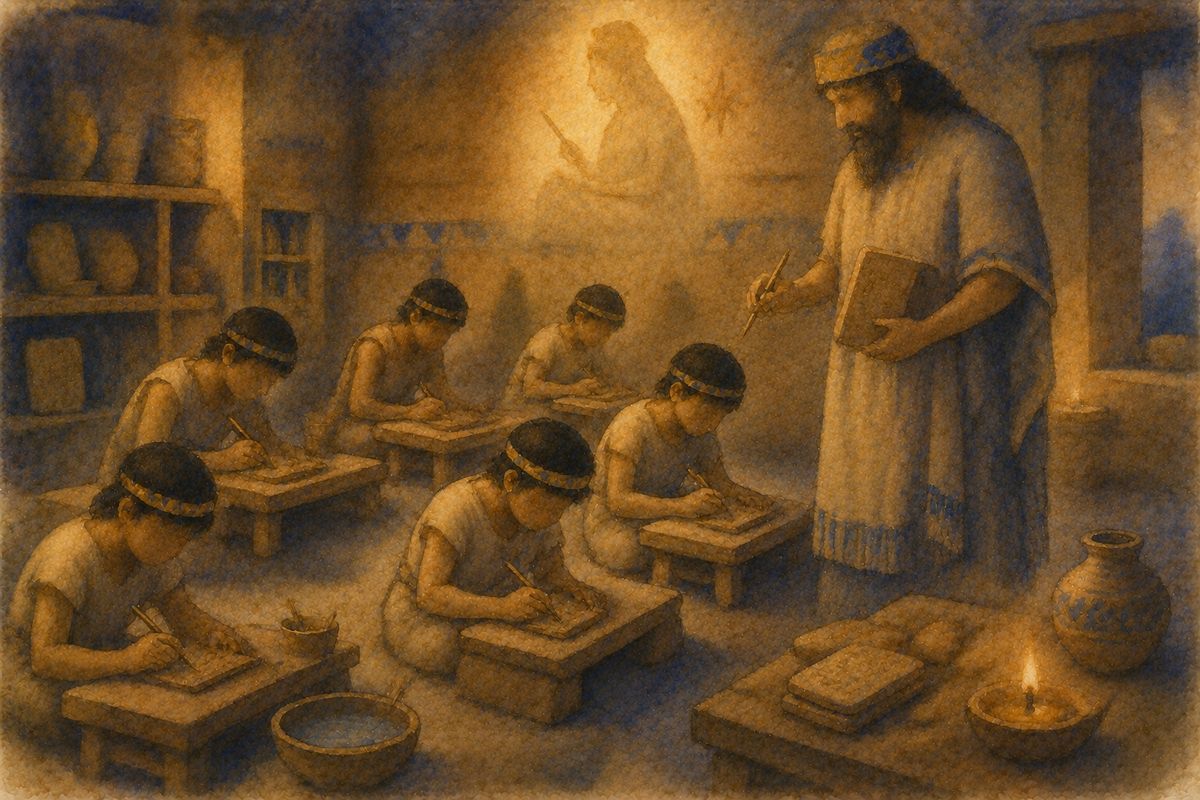
Reading it was a craft. Signs could stand for whole words or for syllables, and a trained scribe learned hundreds of them in special schools. Scribes were among the most respected people in the ancient world, and the goddess of writing herself, Nisaba, was honoured as their patron. The last known cuneiform tablet was written close to the first century CE, after which the knowledge faded for nearly two thousand years.
Reading the wedges again
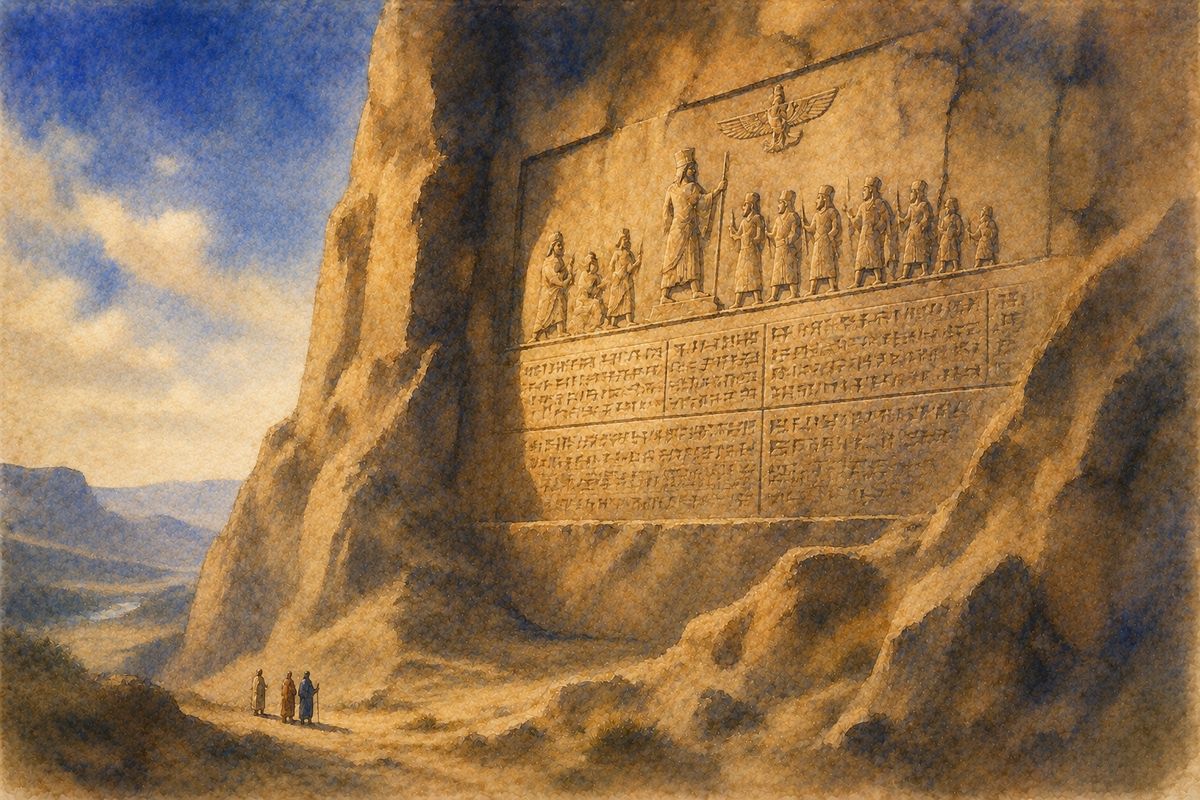
For centuries the tablets were mute. Decipherment came in the nineteenth century, helped by great trilingual inscriptions like the one carved on a cliff at Behistun in Iran, which let scholars match a known language against the unknown wedges.
Once the code broke open, a whole civilisation spoke again. Cuneiform tablets have given us the first law codes, the first named authors, school exercises, astronomical records, business contracts, and the Epic of Gilgamesh. Museums hold hundreds of thousands of them, and many have never been read. The past is still being translated.
What is attested, and what we added
Every factual page here is written against a canon record card that separates the evidence from the retelling, claim by claim. This is that card, shown in full.
Period: Uruk period, Mesopotamia (~4th millennium BCE)
What the record supports
- Writing emerged from accounting: clay tokens -> sealed clay envelopes (bullae) -> impressed tablets -> pictographs -> cuneiform.
- Early Uruk tablets are overwhelmingly administrative (rations, livestock, labor).
- Signs were impressed in wet clay with a reed stylus; Uruk IV signs are more pictographic, Uruk III more abstract.
What our story adds
The chronicle adds a set of marks that are not cuneiform and never were, belonging entirely to its invented layer. Everything this page states about how writing actually began is the record's, not ours.
What we never claim
That anyone taught the Sumerians to write. Writing here is a human invention, arrived at by accountants keeping track of grain, and nothing in our story changes that.
Sources
- Reference
HIST_CUNEIFORM- Last reviewed
Suggested citation: Chronicles of Uruk, “Cuneiform and the first writing” (HIST_CUNEIFORM), reviewed 2026-07-26.
Readings of Sumerian signs and names are the standard scholarly ones where a value is well attested, and are flagged for specialist review where it is contested. If you find an error, we want to hear about it.
Cuneiform in the Chronicle
Chronicles of Uruk lets you meet these signs for yourself. In the free Long Record you can learn to read a handful of real cuneiform marks and even see your own name pressed into clay, the way a scribe once borrowed signs for their sound.
That part is not invented. The signs are real, and once you can read a few, you never look at a museum tablet the same way again.
Common questions
- What language is cuneiform?
- Cuneiform is a writing system, not a language. It was first used to write Sumerian, then adapted for Akkadian, Babylonian, Assyrian, Hittite, and several other languages over three thousand years, much as our own alphabet writes many different tongues.
- How do you read cuneiform?
- A cuneiform sign can stand for a whole word or for a syllable of sound, and readers use context to tell which. Ancient scribes trained for years to master hundreds of signs. You can learn a few of the oldest ones in the free Long Record.
- How was cuneiform deciphered?
- It was cracked in the nineteenth century, largely thanks to long royal inscriptions written in three languages at once, such as the Behistun inscription. Matching a known language against the unknown signs let scholars work out the values, and a lost world began to speak again.
Keep reading
The Anunnaki
Who the Anunnaki actually were in Sumerian belief, and how a family of ancient gods became a modern myth.
The Epic of Gilgamesh
Humanity's oldest surviving story: a restless king, a wild man made to match him, and a journey to the edge of death.
Inanna, queen of heaven
The goddess of love and war whose eight-pointed star became our mark, and the oldest story of a god who dies and returns.
Uruk, the first great city
The Sumerian city that gave an age its name, home to the world's earliest writing and the king who became its oldest legend.
Nippur
The religious centre of Sumer, which granted kingship and never held it.
Ur
The moon god's city, its great ziggurat, and the last Sumerian-speaking state.
Related dispatches
All dispatchesArticle
The oldest road down, and what we changed
An Adventure Chamber built line by line from a four thousand year old Sumerian poem. Here is exactly what we kept, what we added, and where to check us.
Article
Write your name in clay
Type your name and watch it pressed into cuneiform, the way a scribe once borrowed signs for their sound. Then keep it, or share it.
Article
The Long Record: walk six thousand years of Sumer
A new way into the world. A guided walk through real history, its myths, and the first writing humanity ever kept, with signs you can learn to read.
Keep exploring the Chronicle