History
Cylinder seals: identity you could roll
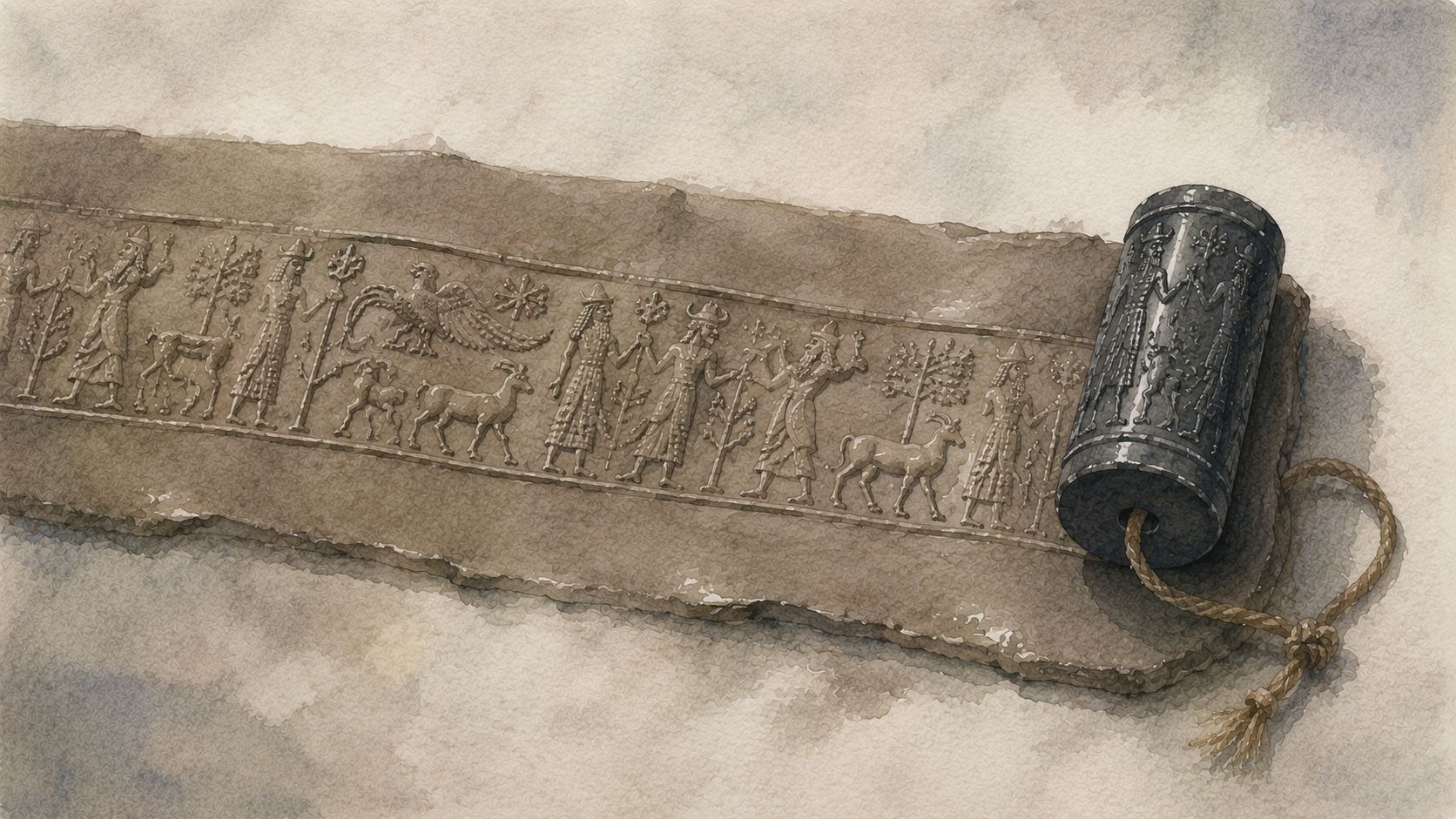
A stone the size of your thumb, carved in reverse, worn on a cord. Roll it across wet clay and it leaves a repeating picture that says who you are and that you agreed to this.
The cylinder seal is the most Mesopotamian object there is, and one of the most quietly ingenious things anyone has invented. It solves signature, security and identity at once, in a material that was lying around in unlimited quantities.
It is also, for us, one of the richest surviving bodies of ancient art. Tens of thousands of them exist, carved across three thousand years, and because they were personal they show what people actually wanted to look at.
Carved backwards, in stone, at that size
A cylinder seal is a small cylinder of hard stone, often a centimetre or two long, carved in intaglio, meaning cut into the surface rather than raised from it, and carved in reverse so that the impression reads correctly.
Hold those constraints together for a moment. The carver is working below actual size, in a hard material, cutting negative shapes, mirror-reversed, so that a picture nobody will see until it is rolled comes out right. Some of the finest are worked in lapis, carnelian, hematite and rock crystal.
They were worn, usually on a cord at the wrist or neck. Your identity was a physical object you carried, which is a very different relationship to identity than a signature on file somewhere.
A signature and a lock in one motion
Rolling a seal across wet clay does two jobs at once. On a tablet it authorises: this transaction was witnessed, this account is approved, this person consented. On a lump of clay closing a jar, a door or a bundle, it seals: the clay hardens, and the container cannot be opened without visibly destroying the impression.
That second function is the clever one. It is not merely a lock, because a lock only resists. A sealing produces tamper evidence, so you learn that something was opened even if you could not have stopped it. Fragments of these sealings survive in enormous numbers, often outliving what they were attached to.
Both functions depend on the same property: the image is hard to forge, because reproducing it means reproducing the carved stone.
What the seals show, and what they prove
The subjects change over three millennia and track the culture that made them: presentation scenes where a person is led before a god, contest scenes with heroes and animals, banquets, mythological episodes, and long stretches of ordered geometric pattern.
Because a seal belonged to a person or an office rather than to a temple wall, the corpus is unusually democratic. It preserves the visual world of officials and merchants, not only of kings.
For administration, the implication is the important one. A society that seals is a society keeping track of who agreed to what, and it built that apparatus for itself. Sealing, writing and accounting arrive together and for the same reason, which is that people were counting things and needed to know whose count it was.
What is attested, and what we added
Every factual page here is written against a canon record card that separates the evidence from the retelling, claim by claim. This is that card, shown in full.
Period: Uruk period onward, Mesopotamia
What the record supports
- Cylinder seals were carved in intaglio and in reverse from hardstones, then rolled across wet clay to leave a repeating image.
- A sealing both signed and locked: it authorized records and secured closures, leaving visible tamper evidence.
- Seals identified a person or institution and were worn on a cord — an identity always at hand.
What our story adds
A handful of seals in the chronicle carry a mark of our own invention. The practice around them, the carving, the rolling, the sealing, is the real one.
What we never claim
That Sumerian administration was taught or supplied from outside. Mesopotamians built their own bureaucracy, and the seal is the evidence of exactly that.
Sources
- Reference
HIST_CYLINDER_SEALS- Last reviewed
Suggested citation: Chronicles of Uruk, “Cylinder seals and sealings” (HIST_CYLINDER_SEALS), reviewed 2026-07-26.
Readings of Sumerian signs and names are the standard scholarly ones where a value is well attested, and are flagged for specialist review where it is contested. If you find an error, we want to hear about it.
In the Chronicle
A handful of seals in the chronicle carry a mark of our own invention. The practice around them, the carving, the rolling, the sealing, is the real one.
Mesopotamians built their own bureaucracy. The seal is precisely the evidence of that, which is why we do not let the story imply otherwise.
Common questions
- How were they actually used?
- Rolled across the surface of wet clay: on a tablet to authorise or witness it, or on a lump of clay closing a jar, a door or a package. The clay then dried hard, so the impression both identified the sealer and showed whether anything had been opened afterwards.
- Why cylinders rather than stamps?
- Because rolling produces a continuous repeating band rather than a single mark, which covers a larger area, is harder to fake convincingly, and can carry a whole scene with an inscription. Stamp seals existed both before and alongside; the cylinder dominates in Mesopotamia through the long middle of its history.
- Was a seal the same as a signature?
- Close, but it identified a person or an office rather than a hand, and it could be inherited, transferred with a post, or held by a subordinate. It is nearer to a stamp of authority than to a handwriting sample, and losing one mattered a great deal.
Keep reading
When honest tablets disagree
Five sincere accounts of one event, and how to read them.
Foundation deposits
Messages buried in the footings, addressed to the next builder.
The land between the rivers
Silt, irrigation, and a plain with nothing but mud and reeds.
The Anunnaki
Who the Anunnaki actually were in Sumerian belief, and how a family of ancient gods became a modern myth.
Keep exploring the Chronicle