History
When honest tablets disagree
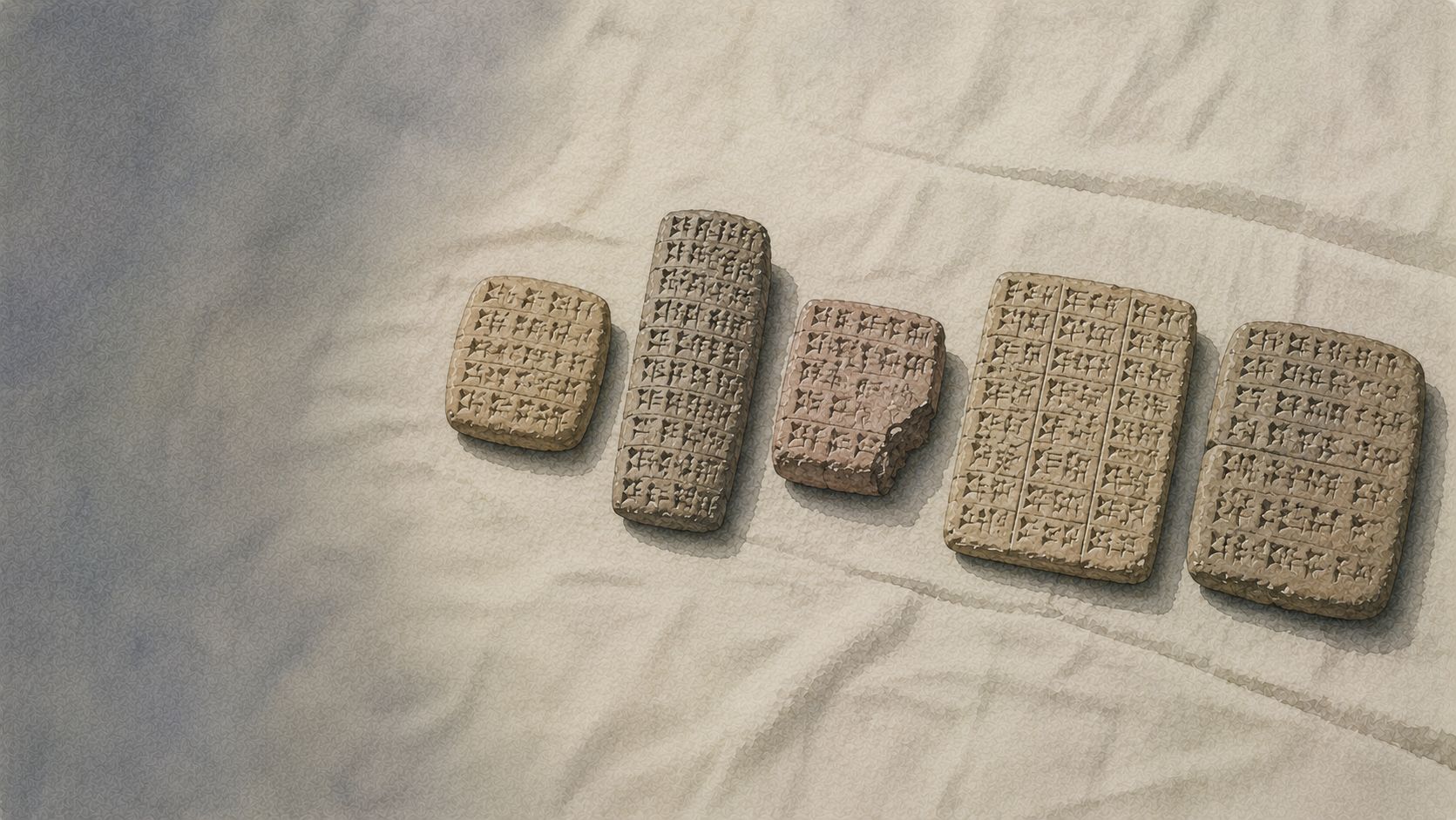
Five scribes can describe one event, none of them lying, and produce five different accounts. That is not a failure of the record. It is what a record made by people looks like, and knowing how to read it is most of the work.
This is the page about method rather than about a place or a thing. It matters because almost every claim on the rest of this site rests on it: when we say something is attested, we are saying that somebody wrote it down for some purpose, and that we have thought about what that purpose was.
The honest position is not that ancient sources are unreliable. It is that they are reliable about different things than they appear to be.
Genre decides what gets written
Cuneiform is not one kind of document. A royal inscription, a year-name, an omen report, a private letter and a city lament are five genres with five different jobs, and each one shapes what a scribe puts down.
A royal inscription exists to say that the king built, conquered and was favoured by the gods. It will not tell you a campaign went badly. A year-name exists to label a year by its most memorable event, so it records what an administration considered worth naming. An omen report exists to note what was observed in the sky and what it was taken to mean. A lament exists to grieve, and grieves in formal language that had already been used for other cities.
None of these is dishonest. Each is answering the question its genre asks. The mistake is to read one as though it were answering a different question, and much of what looks like ancient contradiction is a modern reader doing exactly that.
The sky was recorded, systematically
Mesopotamian scholars kept sustained, organised records of celestial events: eclipses, the movements of planets, comets, unusual skies. The great omen series known as Enuma Anu Enlil collects the readings; other tablets record the observations themselves, night after night, for centuries.
They did this because they believed the sky carried meaning about events on earth. We do not, and that difference is exactly what makes the material so useful. Astronomical observations can be checked against the actual sky by calculation, which turns some of these tablets into fixed points that anchor the whole chronology.
So a body of text produced for reasons we reject entirely provides some of the hardest dating evidence we have. That is worth sitting with, because it is a good argument against dismissing a source because you dislike its worldview.
Reconstructing from witnesses who disagree
Historians work with conflicting, sincere sources as a matter of routine. The method is not to pick the account you like and discard the rest. It is to ask what each source is in a position to know, what it is trying to achieve, and what would have to be true for it to say what it says.
Disagreement between witnesses is evidence of perspective. It is not, on its own, evidence of forgery, and treating it that way throws away the most informative thing about the set: where they diverge tells you where the interests were.
The practical version, which this whole site is built on: state what is attested, name the source, and mark the places where the evidence stops. A page that hedges where the record hedges is more useful than one that sounds certain everywhere, and it is the only kind a specialist will not immediately discount.
What is attested, and what we added
Every factual page here is written against a canon record card that separates the evidence from the retelling, claim by claim. This is that card, shown in full.
Period: Mesopotamia, 3rd to 1st millennium BCE
What the record supports
- Different cuneiform genres could record the same event in sincerely different terms: royal inscriptions, year-names, omen reports, letters, and laments each shaped what a scribe wrote by what the genre was FOR.
- Mesopotamian scholars kept systematic records of celestial events (eclipses, comets, unusual skies) and read them as meaningful signs, notably in the omen series Enuma Anu Enlil.
- Modern historians routinely reconstruct events from conflicting-but-honest ancient sources; disagreement between witnesses is evidence of perspective, not necessarily of forgery.
What our story adds
One wall in the chronicle holds five sincere accounts of a single event that do not agree, and the account that survives best is the one that recorded only what was seen and heard. The wall is ours; the principle is real.
What we never claim
That any real tablet records visitors from elsewhere as historical fact.
Sources
- Wikipedia: Enuma Anu Enlil
- ETCSL, Oxford
- Wikipedia: Sumerian King List
- Wikipedia: Lament for Ur
- cdli.earth
- Reference
HIST_WITNESS_TRUTH- Last reviewed
Suggested citation: Chronicles of Uruk, “When honest tablets disagree” (HIST_WITNESS_TRUTH), reviewed 2026-07-26.
Readings of Sumerian signs and names are the standard scholarly ones where a value is well attested, and are flagged for specialist review where it is contested. If you find an error, we want to hear about it.
In the Chronicle
One wall in the chronicle holds five sincere accounts of a single event that do not agree, and the account that survives best is the one that recorded only what was seen and heard, without deciding what it meant.
The wall is ours. The principle is entirely real, and it is the reason the puzzle works.
Common questions
- If sources contradict each other, how can anything be known?
- By asking what each source was for. A royal inscription is excellent evidence for what a king wanted claimed and poor evidence for how a battle went; a ration list is dull and almost impossible to falsify. Contradiction narrows the field rather than emptying it, and the places where independent genres agree are firm ground.
- What is Enuma Anu Enlil?
- A large Mesopotamian series of celestial omens, collecting observations of the sky together with the meanings assigned to them. It is a religious and divinatory document, and it is also, incidentally, a scientific record: the observations in this tradition can be checked by calculation and help anchor ancient chronology.
- Does this mean the history on this site is uncertain?
- It means it is stated with its uncertainty visible. Every factual page here carries a block naming what the record supports, what we added, and what we will not claim, with sources. Where scholars genuinely disagree, we say so instead of picking a side quietly.
Keep reading
Cylinder seals
A signature and a lock in one rolled motion.
Foundation deposits
Messages buried in the footings, addressed to the next builder.
The land between the rivers
Silt, irrigation, and a plain with nothing but mud and reeds.
The Anunnaki
Who the Anunnaki actually were in Sumerian belief, and how a family of ancient gods became a modern myth.
Keep exploring the Chronicle