History
Mesopotamia: the land between the rivers
A flat plain built out of silt, with almost no stone, no timber and no metal of its own. Cities appeared here first anyway, and the shortages are a large part of the reason.
Mesopotamia is a Greek word meaning between the rivers, and the land it names is the alluvial plain laid down by the Tigris and the Euphrates in what is now southern Iraq. Everything else on this site happens here.
It is worth understanding the place physically, because the two facts that shaped it are almost embarrassingly simple: there is water if you move it, and there is nothing else.
A country made of river silt
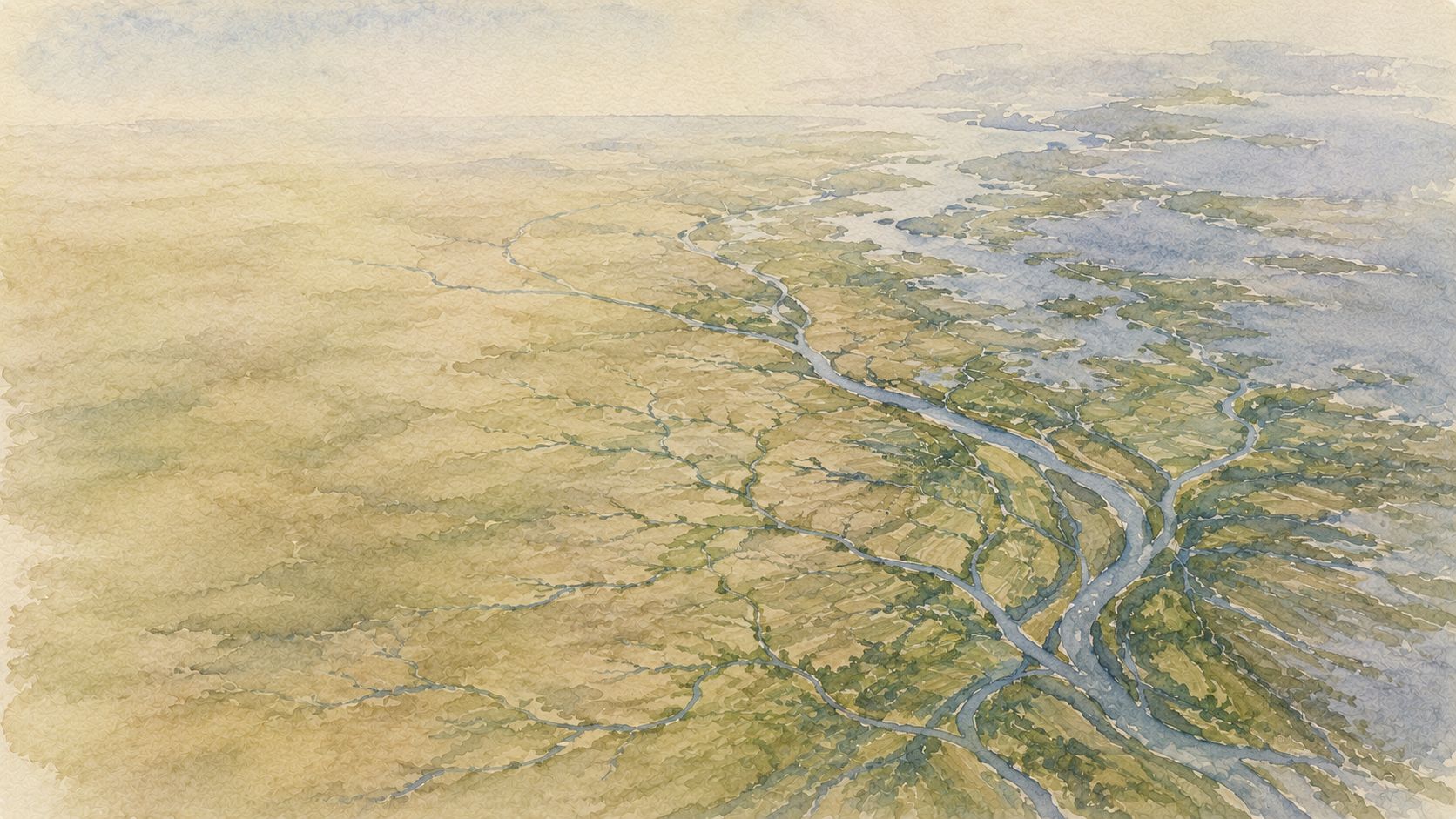
The southern plain is not old rock with soil on top. It is the rivers' own deposit, thousands of years of silt dropped as the current slowed, built up into a nearly level floodplain crossed by shifting channels and, at the southern end, opening into marshes.
Because it is that flat, the rivers wander. A channel that fed a city could and did move, and a city fed by a channel that moved was in serious trouble. Several ancient sites now sit well away from any water at all.
Rainfall in the south is not enough to farm on. That single fact rules out the obvious way of living and forces the other one.
Surplus came from irrigation, and irrigation needs agreement
Water the plain and it is extraordinarily productive. The silt is fertile, the growing season is long, and yields from irrigated barley can be very high.
But irrigation is not something a household does alone. Canals have to be dug, and then they silt up and have to be cleared, every year, forever. Water taken upstream is water not arriving downstream. The work has to be organised, the maintenance has to be enforced, and the disputes have to be settled by someone.
So the surplus that fed the first dense settlements here was not a gift of the land; it was the product of coordinated labour. That is the honest version of why cities appear on this plain: not because it was easy, but because the way to make it productive required people to organise at scale, keep track of obligations, and answer to a centre.
The shortages that built a civilisation
The plain has almost no building stone, very little timber and no metal ore. What it has, in effectively unlimited supply, is mud and reeds.
So people built in mudbrick and reed, and traded for everything else: timber from the mountains, stone, copper, and lapis lazuli that came something like two thousand miles from what is now Afghanistan. A lapis bead in a grave at Ur is a receipt for a trade network crossing mountains and deserts.
And because clay was the material at hand, clay is what they wrote on. That is not a small accident. Papyrus rots and parchment burns, but fired clay is close to indestructible, so a civilisation that wrote on the cheapest thing available is the one whose everyday documents we can still read five thousand years later. The poverty of the plain in every material except mud is the reason we know so much about it.
What is attested, and what we added
Every factual page here is written against a canon record card that separates the evidence from the retelling, claim by claim. This is that card, shown in full.
Period: Ubaid to Uruk periods, southern Mesopotamia (~6th to 4th millennium BCE)
What the record supports
- Mesopotamia means 'between the rivers' (Greek); the land is the alluvial plain built by the silt of the Tigris and Euphrates, in what is now southern Iraq.
- The southern marshes and river channels let farmers irrigate; that surplus, not rainfall, is what first fed dense settlement here.
- The plain has little stone, timber, or metal of its own, so its people built in mudbrick and reed and traded for the rest; clay and reed became the materials of everyday life, including writing.
What our story adds
The chronicle speaks of this plain as old and long-remembering. That is mood, not a claim.
What we never claim
That the rivers, the land or its peoples were made or shaped by anyone from outside the human record, or that the marshes conceal anything of ours.
Sources
- Wikipedia: Mesopotamia
- Wikipedia: Tigris–Euphrates river system
- Wikipedia: Mesopotamian Marshes
- Wikipedia: Ubaid period
- Reference
HIST_LAND_BETWEEN_RIVERS- Last reviewed
Suggested citation: Chronicles of Uruk, “The land between the rivers” (HIST_LAND_BETWEEN_RIVERS), reviewed 2026-07-26.
Readings of Sumerian signs and names are the standard scholarly ones where a value is well attested, and are flagged for specialist review where it is contested. If you find an error, we want to hear about it.
In the Chronicle
The chronicle speaks of this plain as old and long-remembering. That is mood, not a claim.
The rivers, the land and the people who settled it are the record's. We add nothing to them.
Common questions
- Where exactly is Mesopotamia?
- The land between the Tigris and Euphrates, most of which is modern Iraq, with parts extending into Syria, southeastern Turkey and Iran. The Sumerian cities on this site are in the southern alluvial plain, near the marshes and the head of the Gulf.
- Why did the first cities appear here rather than somewhere easier?
- Partly because irrigated farming on this silt produces a very large surplus, and partly because obtaining that surplus requires organisation: canals to dig and clear, water rights to arbitrate, labour to coordinate. The plain rewarded people for building institutions, and those institutions are most of what a city is.
- Why did they write on clay?
- Because clay was the abundant material and stone, timber and papyrus were not. It turned out to be the most durable writing surface anyone has used: clay tablets survive burning, burial and millennia, which is why Mesopotamian daily life is better documented than that of many later and richer societies.
Keep reading
When honest tablets disagree
Five sincere accounts of one event, and how to read them.
Cylinder seals
A signature and a lock in one rolled motion.
Foundation deposits
Messages buried in the footings, addressed to the next builder.
The Anunnaki
Who the Anunnaki actually were in Sumerian belief, and how a family of ancient gods became a modern myth.
Keep exploring the Chronicle