History
Foundation deposits: messages under the floor
When Mesopotamians built a temple, they buried something in its footings that named who built it and for which god. Not decoration, and not quite a time capsule. Something closer to a claim filed where only the next builder would find it.
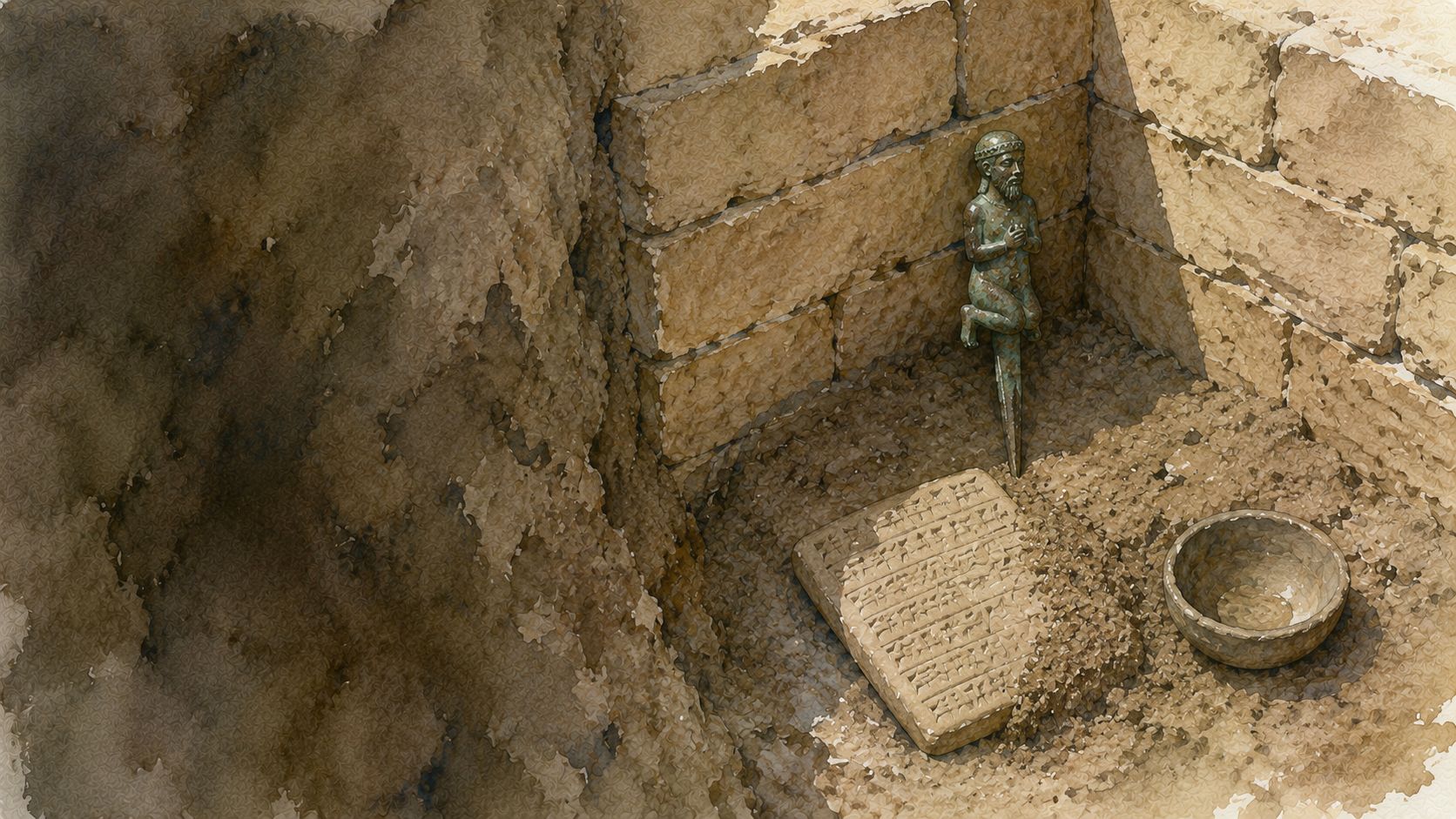
Under the corners and thresholds of Mesopotamian temples, builders placed inscribed tablets, figurines and offerings, sealed into the fabric of the building. They were meant to consecrate the work and to record it, and they were not meant to be read by anyone in that generation.
It is one of the odder habits of the ancient world, and it turns out to be one of the most useful to us.
What went into the ground
A foundation deposit typically named three things: the king who built, the god the building was for, and the work itself. The medium varied with means and period. Clay is common. Stone appears. Some of the most striking are metal: copper or bronze figures, often a kneeling god or a peg, driven into the ground with an inscribed tablet beside them.
The peg form is worth pausing on, because the object is a statement made physical. A nail driven into the earth fixes the building to the ground, and the inscription fixes the claim to the building.
The deposits are usually at corners and under thresholds, sealed where the structure meets the earth. They were placed knowing the building would stand over them for as long as it stood.
A message addressed to the next builder
Here is what makes the practice genuinely strange, and genuinely rational. Mesopotamian temples were rebuilt, repeatedly, on the same footprint, one on the levelled ruin of the last. Everybody involved knew this. It had already happened many times.
So a foundation deposit is addressed to a specific reader: the person who, generations later, digs down to lay a new foundation and finds it. Some inscriptions say so, asking the finder to honour the earlier builder's name and to put the deposit back. It is correspondence across centuries, sent by the only reliable method available, which was to put it where a future builder would necessarily dig.
And it worked. It worked on us, who were not the intended recipients.
Why excavators care so much
A foundation deposit is one of the best pieces of evidence a dig can produce, because it dates a building directly. Most archaeology dates a structure by inference: the pottery in the fill, the layers above and below, the style of the brick. A deposit says which king built it, in writing, in the footings.
That makes them anchors. A securely dated building anchors its layer, and its layer anchors everything found in it.
There is a caution attached. The deposit tells you who claimed the building, which is not always the same as who paid for it or when it was finished, and a later king could rebuild and deposit again. It is excellent evidence, read as what it is: an official statement, deliberately placed, by someone who wanted to be remembered as the builder.
What is attested, and what we added
Every factual page here is written against a canon record card that separates the evidence from the retelling, claim by claim. This is that card, shown in full.
Period: Sumer onward, Mesopotamia
What the record supports
- Mesopotamian builders buried foundation deposits — inscribed tablets, figurines, and offerings — in a temple's footings to record who built it and to consecrate it.
- Foundation tablets were made of clay, stone, or metal and named the king, the god, and the work.
What our story adds
One object in the chronicle is first mistaken for a foundation tablet, which is the whole point of the disguise. The rite it imitates is entirely real.
What we never claim
That foundation deposits were anything other than a human building and religious practice.
Sources
- Reference
HIST_FOUNDATION_TABLETS- Last reviewed
Suggested citation: Chronicles of Uruk, “Foundation tablets and deposits” (HIST_FOUNDATION_TABLETS), reviewed 2026-07-26.
Readings of Sumerian signs and names are the standard scholarly ones where a value is well attested, and are flagged for specialist review where it is contested. If you find an error, we want to hear about it.
In the Chronicle
One object in the chronicle is first mistaken for a foundation tablet, and that mistake is the whole point of the disguise. A dark, too-precisely-made thing in a footing where a plain inscribed one should be.
The rite it imitates is entirely real, and it was a human building and religious practice from beginning to end.
Common questions
- What is a foundation deposit?
- A group of objects, usually an inscribed tablet with figurines and offerings, buried in the footings of a building, most often a temple, to consecrate it and to record who built it and for which god. They are typically found at corners and under thresholds.
- Who were they written for?
- Partly the gods, and partly the next builder. Mesopotamian temples were rebuilt on the same spot repeatedly, so a deposit was placed where a future rebuild would inevitably dig. Some inscriptions address that finder directly and ask them to respect the earlier name and replace the deposit.
- Why are they so valuable to archaeologists?
- Because they date a building directly rather than by inference, naming the ruler who built it in writing, in place. That fixes the structure, and fixing the structure helps fix everything found in the same layer. The caveat is that they record an official claim, which is not always the whole story.
Keep reading
When honest tablets disagree
Five sincere accounts of one event, and how to read them.
Cylinder seals
A signature and a lock in one rolled motion.
The land between the rivers
Silt, irrigation, and a plain with nothing but mud and reeds.
The Anunnaki
Who the Anunnaki actually were in Sumerian belief, and how a family of ancient gods became a modern myth.
Keep exploring the Chronicle