History
Inanna, the queen of heaven
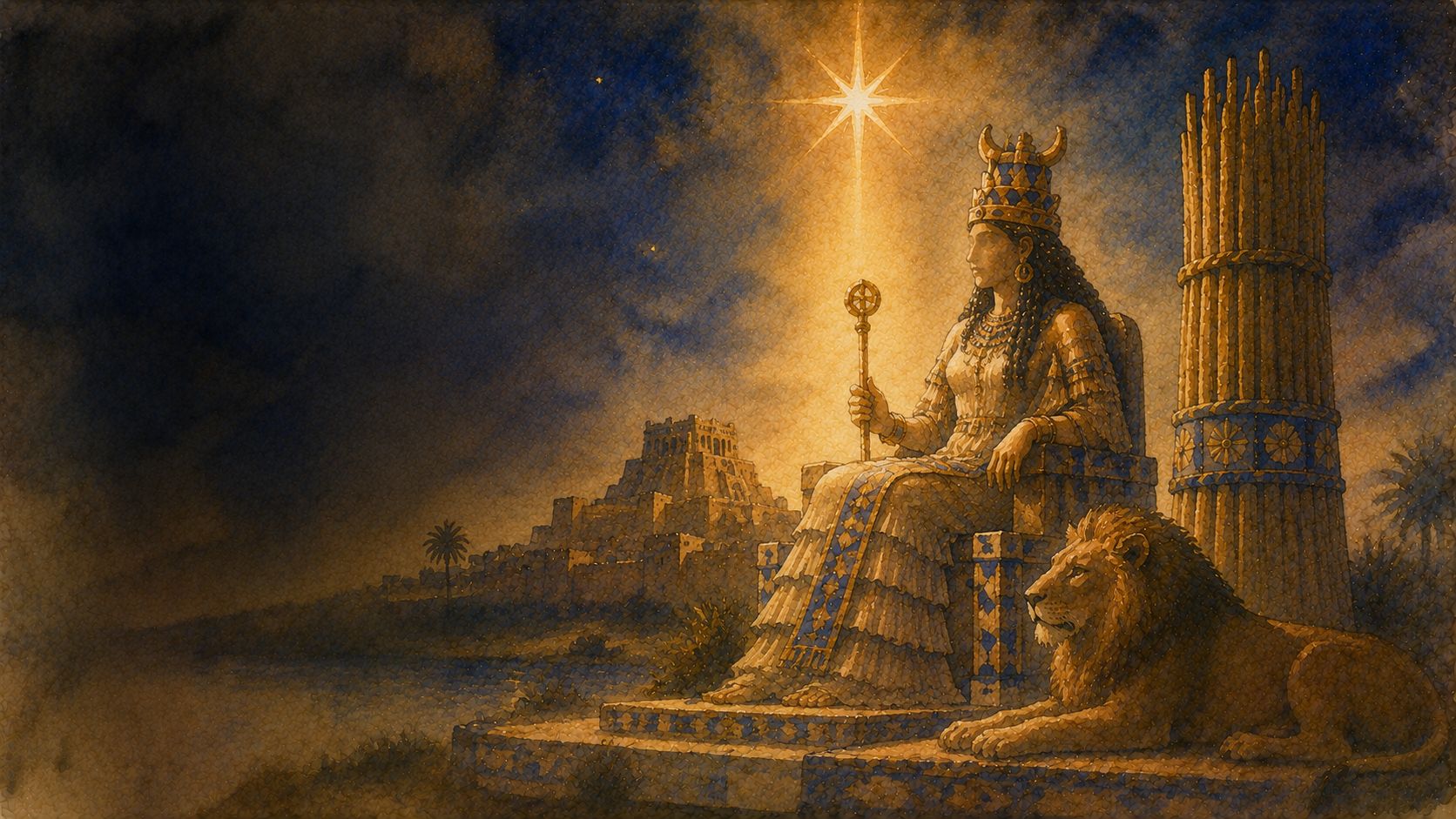
She was the goddess of love and of war, the planet Venus in the morning and again at evening, and the Lady of Uruk itself. The eight-pointed star that marks our chronicle is hers, and it was pressed into clay five thousand years before we borrowed it.
No god of ancient Sumer was written about more than Inanna. She is desire and she is battle, generous and merciless, and the poets never once tried to soften the contradiction. Her house stood at the centre of Uruk, the city where writing began. And the oldest story of a god who dies and returns is hers, set down more than a thousand years before any of the ones we know better.
The Lady of the Eanna, and the star
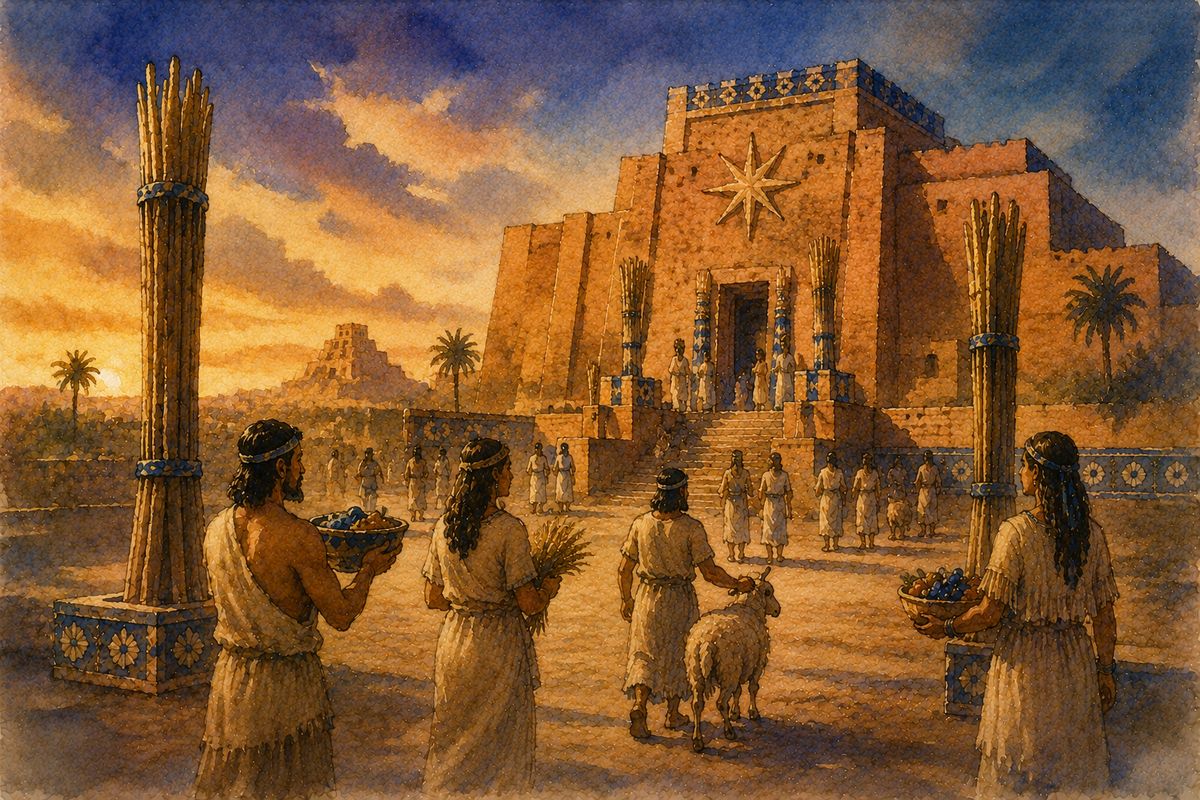
Inanna's temple precinct at Uruk was the Eanna, a name that means simply "house of heaven." It was among the largest sacred complexes in the ancient world, and it stood in the city that gave us the earliest writing we can read. Some of the very oldest tablets ever found are Eanna accounts: barley, sheep, beer, the ordinary business of running her household.
She was identified with the planet Venus, which is why she appears both as the last light of evening and the first of morning, and why the Sumerians could hold her two faces together without difficulty. The same body was both, so the same goddess was both.
Her emblem is an eight-pointed star, sometimes a rosette. You will find it on cylinder seals, boundary stones, and temple walls across three thousand years of Mesopotamian art. It is the oldest symbol we use, and we did not invent a single point of it.
The descent, and the seven gates
The story called "Inana's descent to the nether world" is one of the most complete Sumerian myths we have. Inanna decides to go down to the realm of the dead, ruled by her elder sister Ereshkigal. Before she goes, she leaves instructions with her minister Ninshubur: if I am not back in three days, go and plead for me, first to Enlil, then to Nanna, then to Enki.
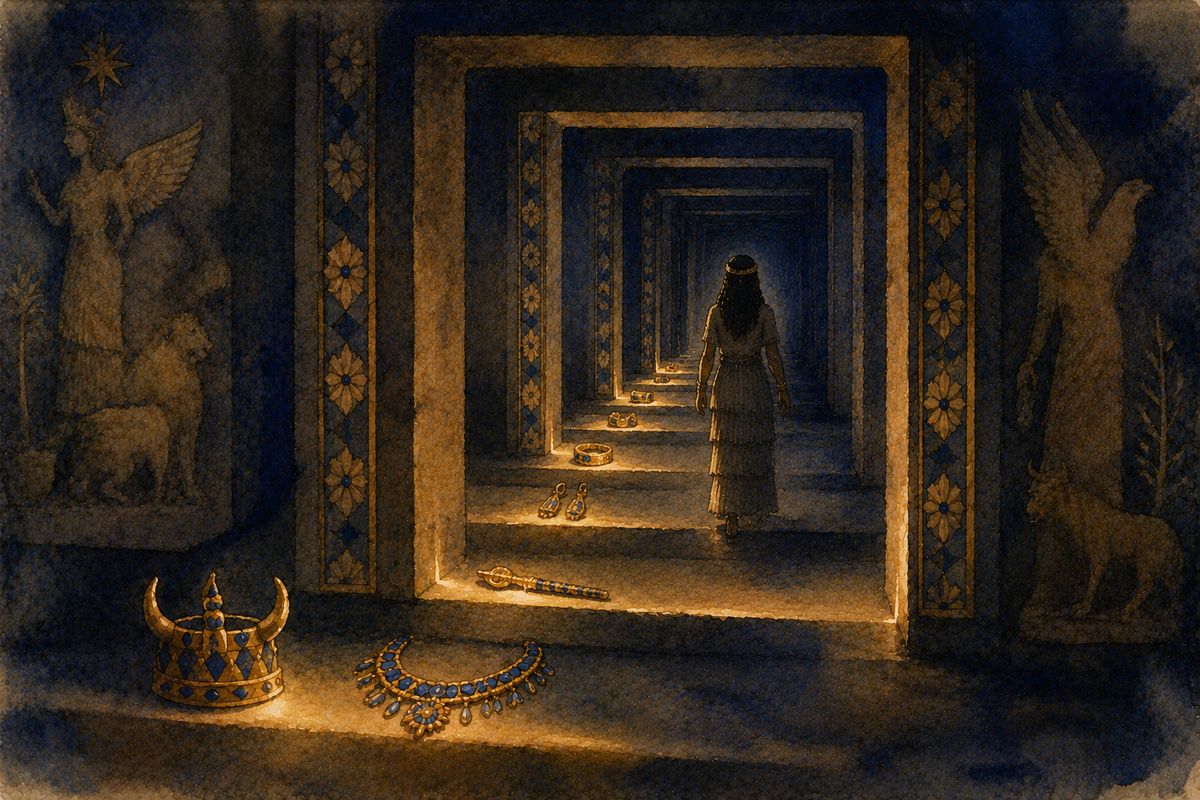
There are seven gates. At each one the gatekeeper takes something from her, one ornament, one garment, one of the me, the divine powers that make her what she is. She protests at every gate and is answered the same way each time: be silent, Inanna, the ways of the underworld are perfect. By the seventh gate she is naked and has no office left. The judges of the dead fix her with a look, and she becomes a corpse, hung on a hook.
Ninshubur does exactly as she was told. Enlil refuses. Nanna refuses. Enki does not refuse. He scrapes the dirt from under his fingernails and makes two small creatures out of it, beings of no rank at all, and sends them down with the food of life and the water of life. They get in precisely because they are nobody. They find Ereshkigal in agony and, instead of demanding anything, simply grieve along with her, until in gratitude she offers them a gift, and they ask for the corpse.
Inanna returns. But the underworld does not release anyone without a replacement, and demons come up with her to collect it. She spares Ninshubur, who mourned her. She spares two others who mourned her. Then she finds her husband Dumuzi seated on his throne in clean clothes, not mourning at all, and she hands him over. His sister Geshtinanna offers to take his place, and in the end the two of them split the year between them, half below and half above. That is the myth's account of why the year has a dying season and a returning one.
Enheduanna, the first author we can name
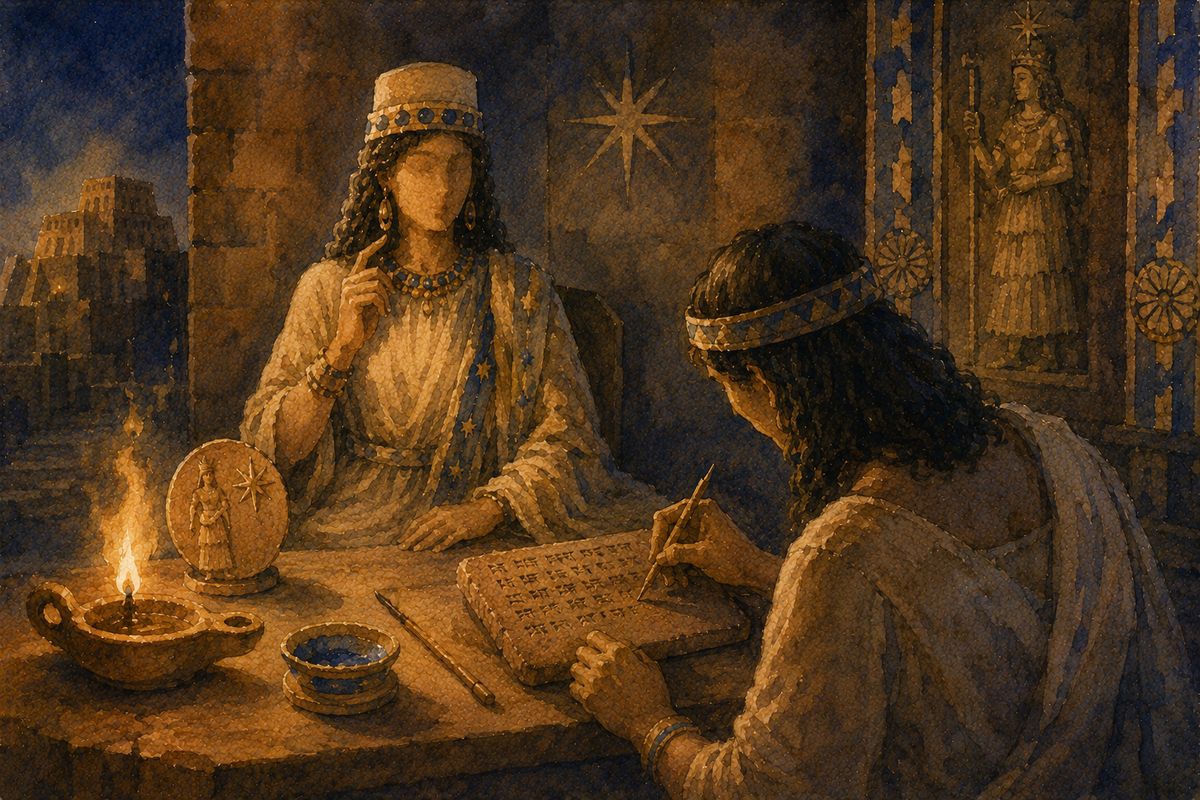
Around 2300 BCE, a woman named Enheduanna served as high priestess at Ur. She was the daughter of Sargon of Akkad, and she wrote hymns, among them a long and fierce poem to Inanna usually called "The Exaltation of Inanna," in which she describes her own political exile and asks the goddess directly for help.
That makes her, so far as we know, the earliest author in human history whose name is attached to their work. Every writer before her is anonymous. It is worth sitting with: the first person to sign their writing was a woman, and she was writing to Inanna.
We should be careful about how we hold this. The surviving copies are Old Babylonian, several centuries after Enheduanna lived, and specialists genuinely disagree about how much of the text is hers and how much accumulated in the copying. What is not in dispute is that she was a real historical person, that the tradition attached her name to these poems, and that no earlier name is attached to any.
What is attested, and what we added
Every factual page here is written against a canon record card that separates the evidence from the retelling, claim by claim. This is that card, shown in full.
Period: Sumerian religion and literature, c. 3200 BCE onward; the Descent survives in Old Babylonian copies, c. 1800 BCE
Written:𒀭𒈹
What the record supports
- Inanna was the Sumerian goddess of love and of war, identified with the planet Venus; the Akkadian tradition called the same goddess Ishtar, and the two merged almost completely.
- Her temple precinct at Uruk was the Eanna, "house of heaven", among the largest sacred complexes of the ancient world; some of the earliest readable tablets are Eanna administrative accounts.
- Her emblem was an eight-pointed star or rosette, used as her sign in Mesopotamian art across roughly three thousand years, on cylinder seals, stelae and temple decoration.
- "Inana's descent to the nether world" (ETCSL 1.4.1) is among the most completely preserved Sumerian myths: she passes seven gates, is stripped of one ornament, garment or `me` at each, is killed by the judges of the dead, and is retrieved after her sukkal Ninshubur petitions Enlil, Nanna and finally Enki.
- In the same composition Enki fashions two creatures of no rank who reach Ereshkigal by grieving with her rather than demanding, and the underworld releases Inanna only against a substitute; she gives Dumuzid, whose sister Geshtinanna then divides the year with him.
- The `me` are the divine ordinances of civilisation (kingship, priesthood, crafts, music, truth), treated in the texts as transferable objects, which is why losing them gate by gate is a loss of office rather than of clothing.
- Enheduanna, high priestess at Ur c. 2300 BCE and daughter of Sargon of Akkad, is the earliest author whose name is attached to surviving work, including the hymn to Inanna known as the Exaltation of Inanna (ETCSL 4.07.2).
What our story adds
The chronicle takes the eight-pointed star as its own mark and treats the Eanna as a real place, because both are real. The descent is read the way the tablets already invite: what an office costs, and what is left of a person once it has been taken one gate at a time.
What we never claim
That the Exaltation of Inanna is Enheduanna's text word for word: the surviving copies are Old Babylonian, centuries later, and specialists genuinely disagree how much accumulated in the copying. That the descent is the source of any later dying-and-returning figure. And nothing of our invented layer is ever attributed to Inanna as though the record supported it.
Sources
- ETCSL, Oxford
- ETCSL, Oxford
- ORACC, Penn
- ORACC, Penn
- Wikipedia: Inanna
- Wikipedia: Eanna
- Wikipedia: Me (mythology)
- Wikipedia: Enheduanna
- Reference
HIST_INANNA_DESCENT- Last reviewed
Suggested citation: Chronicles of Uruk, “Inanna, Venus, and the descent” (HIST_INANNA_DESCENT), reviewed 2026-07-26.
Readings of Sumerian signs and names are the standard scholarly ones where a value is well attested, and are flagged for specialist review where it is contested. If you find an error, we want to hear about it.
Inanna in the Chronicle
The eight-pointed star on our mark is hers. The Eanna is a real place in our world because it was a real place in the world.
We treat the descent the way the tablets do, as a story about what an office costs and what is left of a person when it is taken away, one gate at a time. You do not need to know any of it to play. If you do know it, you will recognise a great deal.
The myth here is the myth. What we invent, we keep clearly on the other side of the line.
Common questions
- Are Inanna and Ishtar the same goddess?
- Effectively yes. Inanna is the Sumerian name; Ishtar is the Akkadian name for the same goddess, and over time the two traditions merged almost completely. Later texts from Babylon and Assyria call her Ishtar while telling recognisably the same stories, including the descent.
- What are the me that she loses at the gates?
- The me are the divine powers or ordinances that make civilisation work, everything from kingship and priesthood to crafts, music, and truth. They are treated almost as objects that can be held, given, and taken. When Inanna is stripped of hers gate by gate, she is not merely being undressed; she is being relieved of her office, piece by piece, until nothing of her authority remains.
- Why is the eight-pointed star her symbol?
- Because she was identified with the planet Venus. The star stands for that body, and Mesopotamian artists used it as her sign for roughly three thousand years, on seals, stelae, and temple decoration. It is one of the longest-lived symbols in human history.
Keep reading
The Anunnaki
Who the Anunnaki actually were in Sumerian belief, and how a family of ancient gods became a modern myth.
Cuneiform, the first writing
How marks pressed into wet clay five thousand years ago became the first writing, and what the tablets still say to us.
The Epic of Gilgamesh
Humanity's oldest surviving story: a restless king, a wild man made to match him, and a journey to the edge of death.
Uruk, the first great city
The Sumerian city that gave an age its name, home to the world's earliest writing and the king who became its oldest legend.
Related dispatches
All dispatchesKeep exploring the Chronicle