History
Ur, the city of the moon
The moon god's house, the great stepped tower still standing over a flat plain, and the graves that gave the world its first real look at what Sumerian wealth actually looked like. Ur is also where the last Sumerian-speaking state rose and fell.
Ur is the Sumerian city most people have half-heard of, usually for the wrong reason. It is worth meeting on its own terms: the seat of the moon god Nanna, the capital of the Third Dynasty that was the last great state to speak Sumerian, and the site where Leonard Woolley opened the Royal Cemetery in the 1920s and found lyres, headdresses and lapis lazuli that changed what the modern world thought Sumer had been.
In the tradition that Inanna's descent follows, Nanna is Inanna's father. A plea carried to Ur is a plea carried to her own family.
Nanna's house and the tower over it
Ur, Sumerian Urim, stood on the Euphrates in what is now Dhi Qar in southern Iraq. The mound is called Tell el-Muqayyar. Its patron was the moon god Nanna, called Suen or Sin in Akkadian, whose consort was Ningal.
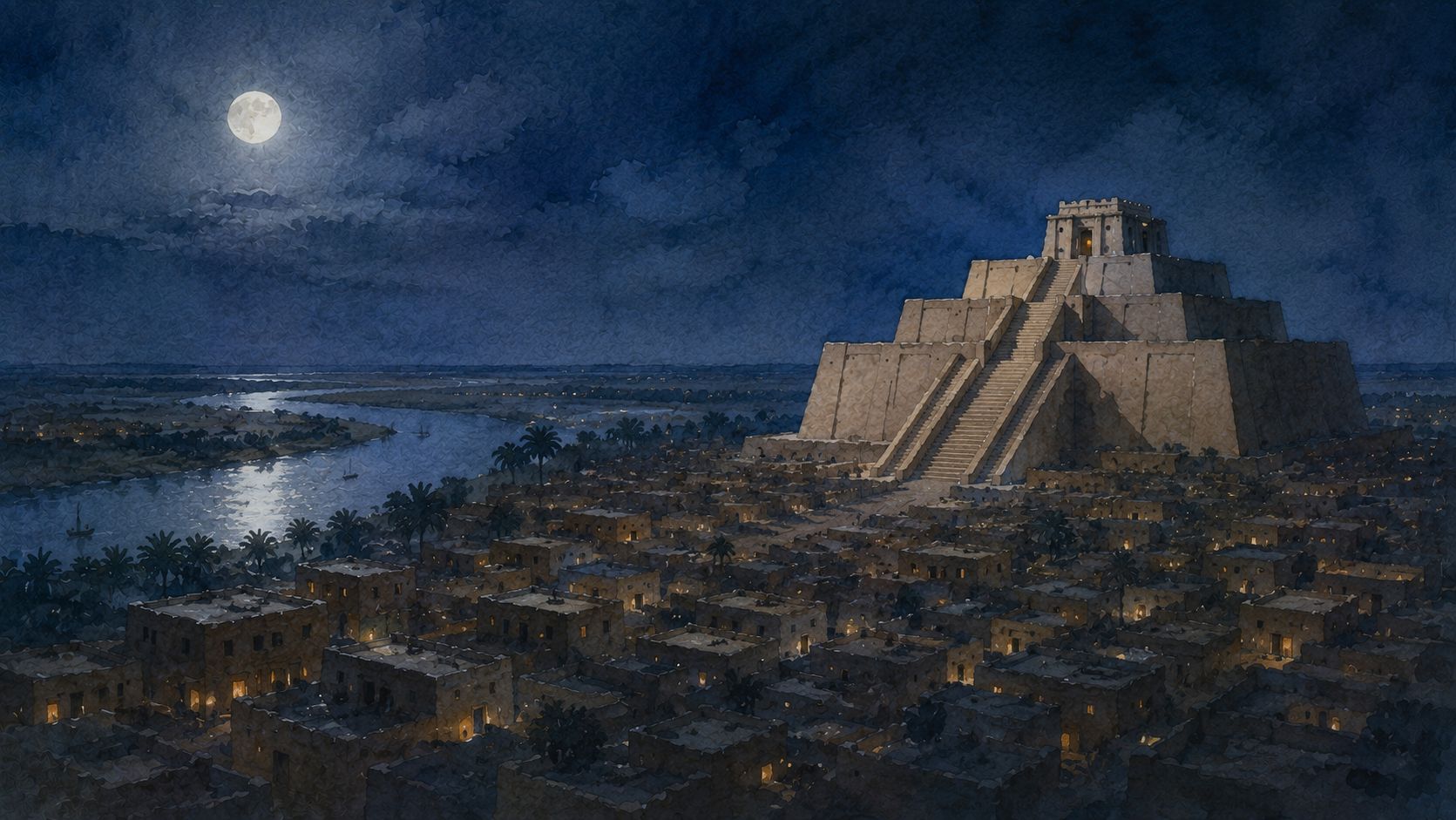
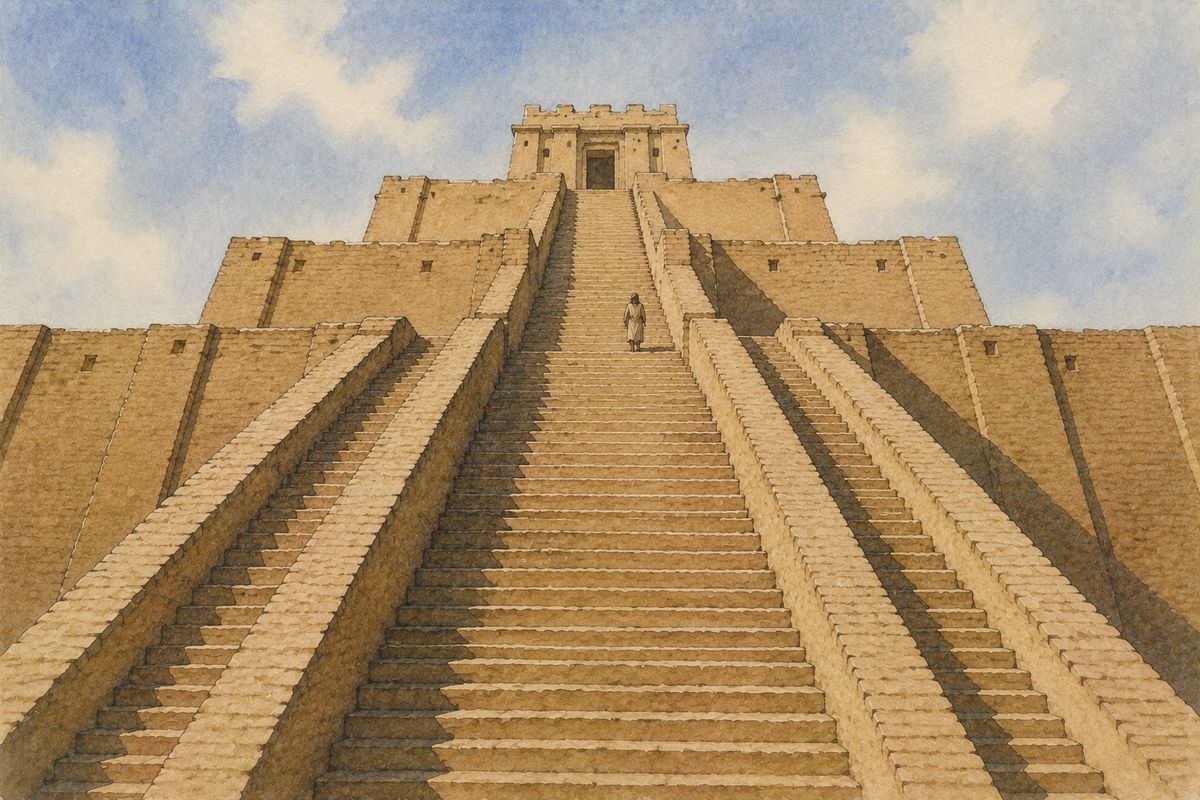
Around 2112 BCE Ur-Nammu raised the great stepped tower over Nanna's house, the structure we call a ziggurat. Its lowest stage has since been reconstructed, and it stands today over a flat plain, which is roughly the opposite of how it was meant to be seen: it was built to be the high point of a crowded city.
A ziggurat is not a pyramid and was never a tomb. It was a platform, a way of raising the god's house above the ordinary ground, and the temple proper stood on top.
The last great Sumerian state
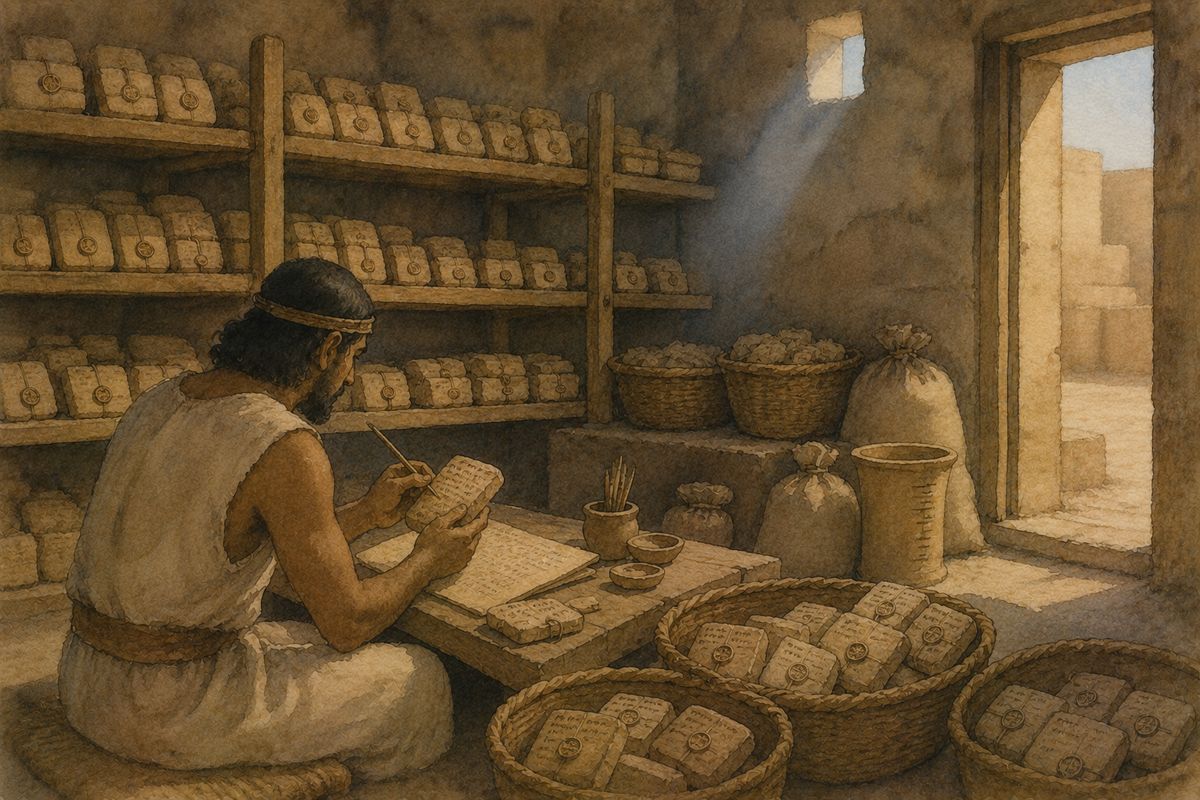
Ur-Nammu founded the Third Dynasty of Ur around 2112 BCE, and his son Shulgi followed him and ran an administration so thorough that it left tens of thousands of tablets: receipts, quotas, deliveries, the paperwork of a state that counted things.
It was the last great Sumerian-speaking state. It fell around 2004 BCE under Ibbi-Sin, to Elam and its allies, and the fall was mourned in a composition called the Lament for Ur, one of a small group of city laments that are among the most affecting things Sumerian literature produced.
After that, Sumerian stops being a language anyone grows up speaking. It carries on for another sixteen centuries as a language of learning and liturgy, copied by scribes who had to be taught it, which is a strange and rather moving afterlife for a tongue.
Woolley, Puabi, and the Royal Cemetery
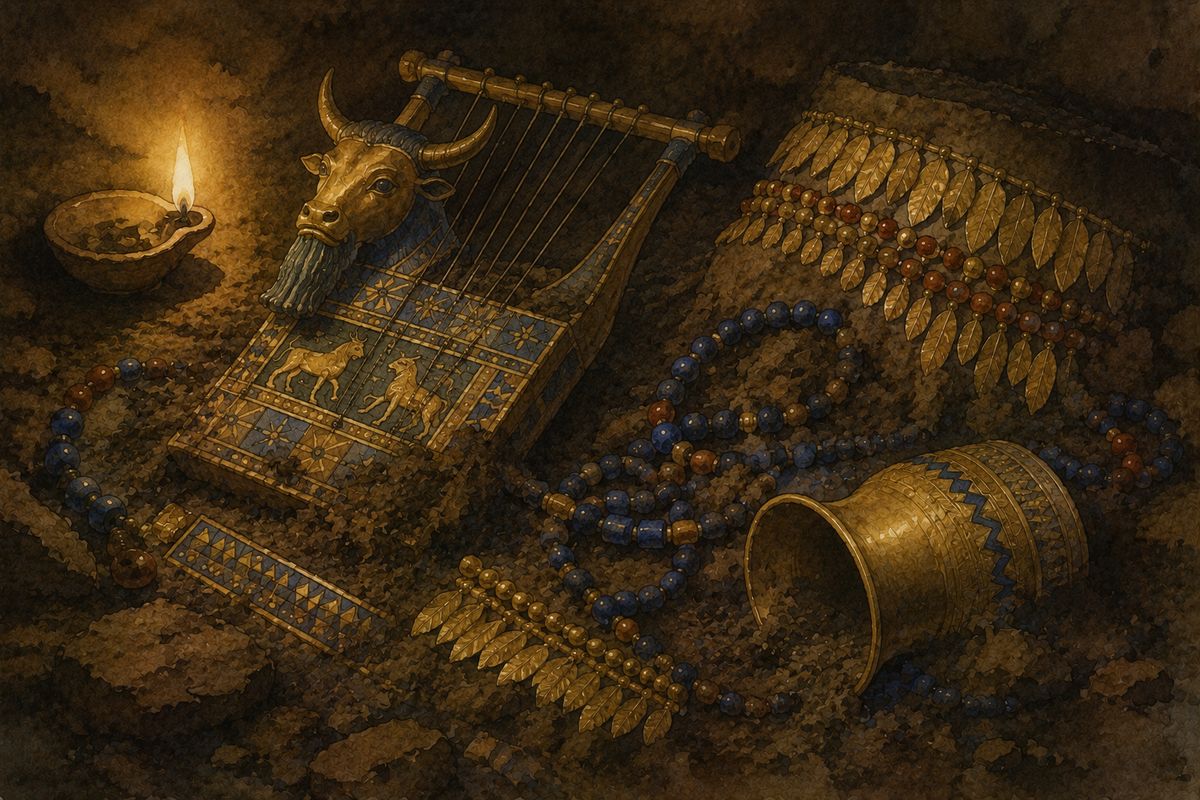
Leonard Woolley excavated Ur between 1922 and 1934 and found the Royal Cemetery, including the tomb recorded as Puabi's. The objects are extraordinary: lyres, elaborate headdresses of gold and carnelian, and quantities of lapis lazuli that had travelled some two thousand miles from what is now Afghanistan to reach a grave in southern Iraq.
That trade distance is the fact worth holding onto. Lapis does not occur in Mesopotamia. Every bead of it in those graves is evidence of a supply chain running across mountains and deserts in the middle of the third millennium BCE.
One thing to be careful about: Ur is often identified with the biblical "Ur of the Chaldees". That identification is genuinely disputed among specialists, and we do not state it as settled. It is a real question with a real argument on both sides, which is a better thing to tell a reader than a confident answer.
What is attested, and what we added
Every factual page here is written against a canon record card that separates the evidence from the retelling, claim by claim. This is that card, shown in full.
Period: Southern Mesopotamia; royal tombs mid-3rd millennium BCE, the Third Dynasty of Ur ~2112 to 2004 BCE
Written:𒋀𒀕𒆠
What the record supports
- Ur, Sumerian Urim, stood on the Euphrates in what is now Dhi Qar in southern Iraq; the mound is called Tell el-Muqayyar. Its patron was the moon god Nanna, Akkadian Suen or Sin, whose consort was Ningal, and in the tradition the Descent follows Nanna is Inanna's father.
- Ur-Nammu founded the Third Dynasty of Ur around 2112 BCE and raised the great stepped tower over Nanna's house; his son Shulgi followed him. The dynasty was the last great Sumerian-speaking state, and it fell around 2004 BCE under Ibbi-Sin to Elam and its allies, a fall mourned in the Lament for Ur.
- Leonard Woolley excavated the site between 1922 and 1934 and found the Royal Cemetery, including the tomb recorded as Puabi's, with lyres, headdresses and quantities of lapis lazuli now held in museum collections. The ziggurat's lowest stage has been reconstructed and stands over a flat plain today.
What our story adds
That a plea carried to Ur is heard as a plea to Inanna's own father, and that the moonlight there has a patient quality the story leans on. Atmosphere only.
What we never claim
That Ur was founded, built, taught or governed from outside; that its ziggurat is anything other than Nanna's tower; that the royal graves hold anything of ours. The identification of Ur with the biblical 'Ur of the Chaldees' is disputed among scholars and is never stated here as settled.
Sources
- Wikipedia: Ur
- Wikipedia: Ziggurat of Ur
- Wikipedia: Third Dynasty of Ur
- Wikipedia: Puabi
- ORACC, Penn
- ETCSL, Oxford
- Reference
HIST_UR
Suggested citation: Chronicles of Uruk, “Ur, the moon's city” (HIST_UR), reviewed .
Readings of Sumerian signs and names are the standard scholarly ones where a value is well attested, and are flagged for specialist review where it is contested. If you find an error, we want to hear about it.
Ur in the Chronicle
A plea carried to Ur is understood as a plea carried to Inanna's own father, and the moonlight there has a patient quality the story leans on.
That is atmosphere, drawn from the city's real character rather than added to it. The ziggurat is Nanna's tower and nothing else, and the royal graves hold what the excavation found in them.
Common questions
- Is this the Ur of the Bible?
- Possibly, and it is genuinely disputed. The identification of this Ur with the "Ur of the Chaldees" named in Genesis has been argued both ways by specialists, with an alternative northern location proposed. We are not going to tell you it is settled, because it is not.
- What actually is a ziggurat?
- A stepped platform raising a temple above the surrounding ground, built of mudbrick with a fired-brick skin. It is not a tomb and not a pyramid, and nobody was buried inside one. The temple stood on the top stage; the mass beneath it is structure, not chambers.
- Who was Puabi?
- A woman of high status buried in the Royal Cemetery with exceptional grave goods, identified by a seal found with her. Her title has been read as "queen" or as a priestly rank, and the argument is not fully resolved. What is not in doubt is the wealth of the burial and the distance the materials in it had travelled.
Who ruled here
Named rulers our record ties to this city. Each page says whether the evidence is an object made in their lifetime or a list written long after.
Keep reading
Uruk, the first great city
The Sumerian city that gave an age its name, home to the world's earliest writing and the king who became its oldest legend.
Nippur
The religious centre of Sumer, which granted kingship and never held it.
Eridug
Where the Sumerians believed the world's first city stood, and kingship first came down.
Nineveh
The Assyrian capital, and the library whose burning preserved the oldest story.
Keep exploring the Chronicle